
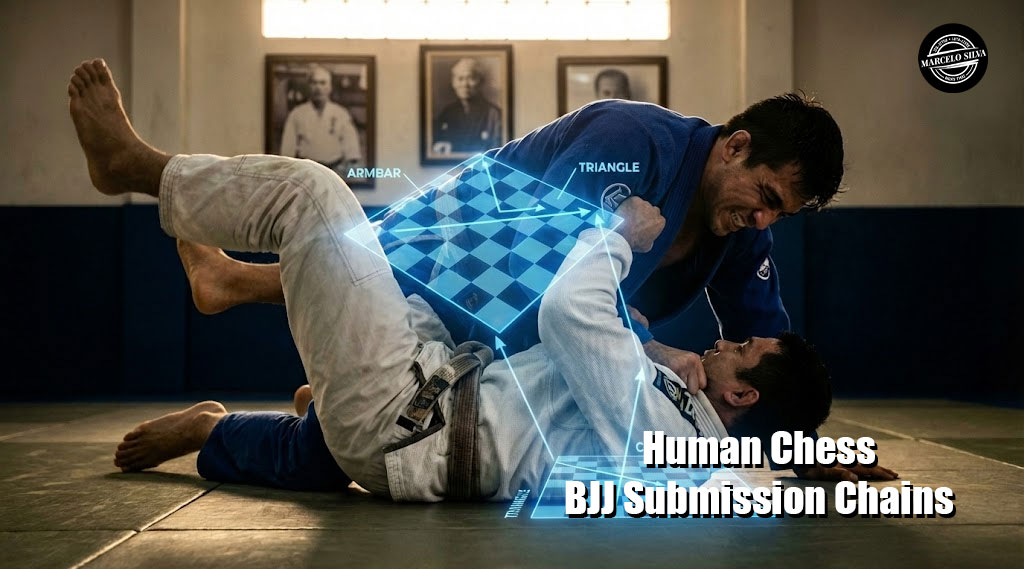
“Human Chess” Complete Guide: How to Build a “Submission Chain” from 2 Basic Moves
Have you ever heard the saying that Brazilian Jiu-Jitsu is “Human Chess”?
This isn’t just a catchy marketing phrase; it is the deepest truth of the art. True BJJ is not a battle of brute strength; it is a battle of intellect—of seeing three or four moves ahead and setting sophisticated traps.
The Problem: The biggest hurdle for beginners (especially white belts) is the “One-Move Mindset.” You attempt an Armbar. It fails. You don’t know what to do next. The game stalls, and you reset. This is the primary reason why students plateau.
The Solution: This article is your complete guide to graduating from a “player” to a “strategist.” We will dive deep into the concept of the “Submission Chain” and why it is the master key to unlocking your potential at BJJ Bangkok.
This approach is the core of the Marcelo Silva Martial Art philosophy: transforming students from those who merely “do moves” into those who truly “understand the game.”
Part 1: What is a "Submission Chain"?
-
Leveling Up from “Fighter” to “Planner”
A Submission Chain is not simply executing Move A, followed by Move B. It is the art of forcing your opponent to react to Move A in a predictable way. Their defensive reaction to the first threat is exactly what creates the opening for the second.
As outlined in the history of Brazilian Jiu-Jitsu (Wikipedia), the art was designed for a smaller person to defeat a larger one. You cannot force a move on a stronger opponent, but you can trick them into giving you what you want.
The Philosophy of “Human Chess”
In Chess (Wikipedia), you don’t move a Knight simply hoping to capture the King in one turn. You move the Knight to force the opponent to move a Pawn, which opens a lane for your Rook.
BJJ is identical. You don’t always attempt an Armbar to finish the match. Sometimes, you attempt the Armbar solely to force them to pull their arm back, which exposes their neck for a Triangle Choke.
Expert Insight: A white belt attacks hoping it works. A black belt attacks knowing exactly what they will do when the opponent defends.
Part 2: "The Classic Combo"
Decoding the Armbar ➡️ Triangle from Closed Guard
This is one of the most classic and effective chains in Jiu-Jitsu. It relies on the “Push/Pull” mechanic.
Attack A (The Threat): The Armbar
-
The Setup: From Closed Guard, secure a “two-on-one” grip (same-side wrist and elbow).
-
Create Angle: Hip escape (shrimp) to the side to create a perpendicular angle.
-
The Attack: Swing your leg over their head and pinch your knees.
The Predictable Reaction
What will 99% of opponents do here? To save their arm, they will violently pull their arm back and posture up (lift their head) to stack you.
This is not a failure; this is the trap.
Attack B (The Trap): The Triangle Choke
The transition happens in the “Golden Moment”—the split second they rip their arm free.
-
The Trigger: As they pull their right arm out, their left arm is usually still posted on your body or the mat.
-
The Switch: Do not fight to keep the Armbar. Instead, release the leg that was over their head and shoot it over their left shoulder.
-
The Lock: Your hips shoot up, and you lock your legs in a Figure-Four.
The Lesson: You used the Armbar to create the Triangle. This systematic approach is what we emphasize in our curriculum at Marcelo Silva Martial Art.
Part 3: "The Power Combo"
Decoding the Cross-Collar Choke ➡️ Armbar from Mount
This chain creates a “Dilemma”—forcing your opponent to choose between two bad options.
Attack A (The Threat): The Cross-Collar Choke
-
Position: Establish a high, stable Mount.
-
The Grips: Insert one hand deep into the collar (palm up), then cross the other hand over for the second grip.
-
Pressure: Begin to apply the choke. This threatens their breathing and creates panic.
The Predictable Reaction
The universal human instinct when being choked is to protect the neck. The opponent will bring their arms up to push your wrists or elbows away.
Attack B (The Trap): The Armbar from Mount
-
The Trigger: When they lift their elbow to defend the neck, that elbow becomes isolated from their body.
-
The Pivot: Release the choke and immediately switch your grip to their exposed arm.
-
The Finish: Slide your knee into “S-Mount,” swing your leg over their head, and take the Armbar.
The Dilemma:
-
Option 1: They defend the neck $\rightarrow$ You break the arm.
-
Option 2: They defend the arm $\rightarrow$ You choke them.
This is the definition of control.
Part 4: How to Smartly Train "Submission Chains"
You cannot learn this by simply “rolling” (sparring) aimlessly. You need Positional Sparring.
Drill 1: The Guard Lab
Start in Closed Guard. Your specific goal is to hit the Armbar-Triangle chain. Your partner provides 70-80% resistance. If the chain fails or they pass your guard, reset immediately.
Drill 2: The Mount Lab
Start in Mount. Your goal is to threaten the Choke to set up the Armbar. Your partner’s only goal is to survive and escape.
At BJJ Bangkok, our classes are structured to ensure you get this type of specific, systematic practice. We don’t just teach random moves; we teach systems that connect.
Conclusion: Stop Playing Checkers
The journey from white belt to colored belt is the journey from fighting to strategizing. Understanding how to build a Submission Chain changes your mindset from “I hope this works” to “I know exactly how to make him give me this submission.”
Are you ready to stop playing checkers and start playing Human Chess?
Join us on the mats. Visit Marcelo Silva Martial Arts or check out our schedule at BJJ Bangkok to begin your journey as a true mat strategist today.
Frequently Asked Questions (FAQ)
Q1: What is a Submission Chain? A Submission Chain is a series of attacks where the first move forces a predictable reaction from the opponent, which opens up the second (and real) attack.
Q2: Is the Armbar/Triangle chain suitable for white belts? Yes, absolutely. These are fundamental moves. Learning to link them together is the best way for a white belt to start understanding BJJ theory.
Q3: Can I practice this alone? No. A chain relies on “reaction.” You need a training partner to give you that realistic reaction.
Q4: Where can I learn these systems in Bangkok? We specialize in this systematic approach at BJJ Bangkok (Marcelo Silva Martial Arts). Our curriculum is designed to teach concepts, not just isolated techniques.
การฝึก Brazilian Jiu Jitsu in Bangkok เป็นการลงทุนที่คุ้มค่าในตัวคุณเอง ทั้งด้านร่างกาย จิตใจ และทักษะการป้องกันตัว หากคุณหลีกเลี่ยงข้อผิดพลาดข้างต้น และฝึกฝนอย่างต่อเนื่อง คุณจะพัฒนาตัวเองอย่างก้าวกระโดดแน่นอน
At BrazilianJiuJitsuBKK.com, we welcome students of all levels. Our experienced instructors, international community, and central Bangkok location make us the ideal place to begin or continue your Brazilian Jiu Jitsu journey.


 ไทย
ไทย  English