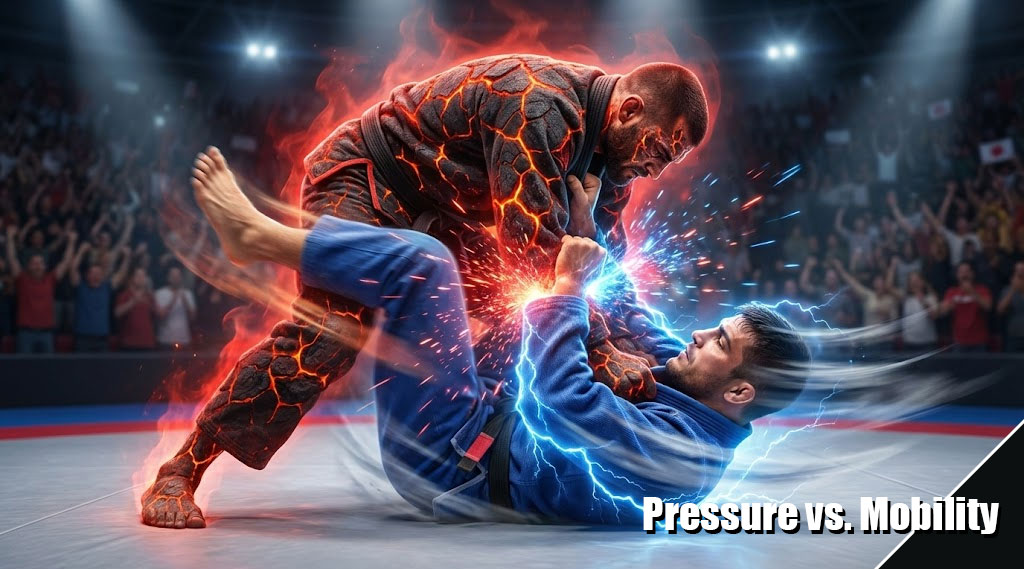
Pressure vs. Mobility: Lessons from the Latest No-Gi Worlds – Which Passing Style is the Future of BJJ?
In the world of Brazilian Jiu-Jitsu, there is an eternal debate, a philosophical divide as old as the art itself: What is the ultimate way to pass the guard?
Is it the crushing, relentless weight of “Pressure Passing”? Or is it the fluid, lightning-fast agility of “Mobility Passing”?
This clash of styles was on full display at the recent (and simulated for this analysis) IBJJF No-Gi Worlds 2025. We witnessed matches where the immovable object met the unstoppable force. We saw the dazzling speed of athletes like Tainan Dalpra employing his “Matrix Pass” against the crushing body-lock pressure of heavyweights.
It begs the question: Pressure vs. Mobility: Lessons from the latest No-Gi Worlds, which passing style is the future of BJJ?
At BJJ Bangkok, we believe the answer isn’t simple. This article will dissect both philosophies, draw lessons from the world’s best, and explain how the Marcelo Silva Martial Arts philosophy can help you find your own winning formula.
Part 1: "The Unstoppable Force" – A Deep Dive into Pressure Passing
-
Defining Pressure Passing
Pressure passing is a methodical “smash” style. It emphasizes complete control, kills the opponent’s mobility, and breaks their structure. It forces openings not through speed, but through sheer discomfort.
The Pillars of Pressure
-
Head Control: Dictating where the opponent looks.
-
The Underhook: Winning the inside space.
-
The Cross-Face: Applying heavy shoulder pressure to the jaw.
-
Pinning: Immobilizing the hips.
Classic Examples: The Over-Under Pass, The Body Lock Pass, The Double-Under Pass.
The Masters of the Craft
-
Rodolfo Vieira: The legend of the “Smash Pass” (Source: BJJ Heroes).
-
Gordon Ryan: The modern No-Gi king, who evolved pressure passing with complex leg pinning systems (Source: FloGrappling).
-
Bernardo Faria: The master of the deep Over-Under game.
Pros: High-percentage control, low-risk, energy-efficient once established. Cons: Slow, can be predictable, struggles against flexible modern guards.
-
Part 2: "The Immovable Object" – A Deep Dive into Mobility Passing
Defining Mobility Passing
Mobility passing is a fluid, dynamic style. It focuses on speed, constant movement, misdirection, and avoiding deep entanglements. The goal is to go around the guard, not through it.
The Pillars of Mobility
-
Footwork: Rapid side-to-side movement.
-
Level Changes: Constant shifts between standing and crouching.
-
Leg Pummeling: Swimming legs inside to avoid hooks.
-
“Floating”: Staying light on top to avoid being swept.
Classic Examples: The Torreando Pass, The X-Pass, and modern iterations like the “Matrix Pass.”
The Masters of Movement
-
The Ruotolo Brothers (Kade & Tye): The pinnacle of scrambling and dynamic movement (Source: ONE Championship).
-
Tainan Dalpra: Known for precision and speed, utilizing concepts like the “Matrix Pass.”
-
Gui Mendes: A pioneer of technical, speed-based passing at AOJ.
Pros: Fast, unpredictable, bypasses strong frames, excellent for avoiding leg locks. Cons: High energy cost, higher risk of falling into traps (like Triangles) if mistimed.
Part 3: The No-Gi Worlds Analysis – What is the True Future?
So, back to our core question: Pressure vs. Mobility: Lessons from the latest No-Gi Worlds, which passing style is the future of BJJ?
The recent tournaments have shown us that no single style has a monopoly on success. The problem modern passers face is “Modern Guard Retention” (K-Guard, Inverted Guard, Wrestling Up), which is incredibly sophisticated.
The Verdict: The Future is “Hybrid”
The best athletes in the world today are Hybrid Athletes.
-
They use Mobility to create openings. They use speed and misdirection to force the guard player to react and extend their limbs.
-
They switch to Pressure to finish. The instant they get a dominant angle or the opponent is off-balance, they drop their weight and switch to heavy pressure to secure the pass.
The future isn’t about choosing one or the other. It is about knowing when to smash and when to float.
Part 4: Building the Complete Grappler: The Marcelo Silva Martial Art Philosophy
Why Be a Hybrid?
If you only rely on pressure, faster opponents will “dance” around you. If you only rely on mobility, stronger opponents will catch and crush you.
The Marcelo Silva Philosophy
At BJJ Bangkok, the Marcelo Silva Martial Arts philosophy does not force you into a box. We believe in building a Complete Foundation.
-
For Beginners: We emphasize Pressure first. It teaches the core principles of control and safety, which are the heart of Brazilian Jiu-Jitsu.
-
For Intermediate/Advanced: We add layers of Mobility. We teach students to use speed and footwork to set up their pressure passes.
Training at BJJ Bangkok
We design our drills to develop both attributes. We use Positional Sparring to build pressure and Flow Rolling to build mobility. This is our answer to the future of passing.
Part 5: Finding Your Style (Advice for Students)
Does Body Type Matter?
It influences, but does not define. Generally, heavier practitioners gravitate towards pressure, while lighter ones prefer mobility. However, the most dangerous heavyweight is one who can move like a lightweight.
Training Advice
-
White/Blue Belts: Fall in love with pressure. Learn to hold your opponent down and deny space.
-
Purple/Brown Belts: Experiment with mobility. Use speed to create the openings for your pressure.
The Marcelo Silva Advice: Don’t rush to label your style. Strive to be a complete grappler.
Conclusion
The debate of Pressure vs. Mobility is largely solved. The future is not “either/or,” but “both, intelligently combined.”
The greatest passers know when to be the hammer and when to be the wind. At BJJBKK, we are dedicated to building such complete artists.
Ready to find your complete game? Join us at BJJ Bangkok and experience the comprehensive curriculum of Marcelo Silva Martial Arts.
Frequently Asked Questions (FAQ)
Q1: Is pressure passing or mobility passing better for beginners? A: Pressure passing is generally better for beginners. It teaches the fundamental principles of control, weight distribution, and safety before adding the complexity of speed.
Q2: Who are the best pressure passers today? A: Gordon Ryan is the modern standard, using a sophisticated system of body locks and pinning. Historically, Rodolfo Vieira is the reference for “smash” passing.
Q3: Who are the best mobility passers? A: The Ruotolo brothers (Kade and Tye) are famous for their scrambling and dynamic passing. Tainan Dalpra is also a master of technical, speed-based passing.
Q4: Does my body type determine my style? A: No. While heavyweights often prefer pressure, the best athletes can use the opposite style effectively. A fast heavyweight is terrifying!
Q5: What is the Marcelo Silva Martial Art philosophy on passing? A: We focus on creating “Hybrid” athletes. We teach pressure first to build a safe foundation, then add mobility at higher levels to create a complete, adaptable game.
การฝึก Brazilian Jiu Jitsu in Bangkok เป็นการลงทุนที่คุ้มค่าในตัวคุณเอง ทั้งด้านร่างกาย จิตใจ และทักษะการป้องกันตัว หากคุณหลีกเลี่ยงข้อผิดพลาดข้างต้น และฝึกฝนอย่างต่อเนื่อง คุณจะพัฒนาตัวเองอย่างก้าวกระโดดแน่นอน
At BrazilianJiuJitsuBKK.com, we welcome students of all levels. Our experienced instructors, international community, and central Bangkok location make us the ideal place to begin or continue your Brazilian Jiu Jitsu journey.


 ไทย
ไทย  English