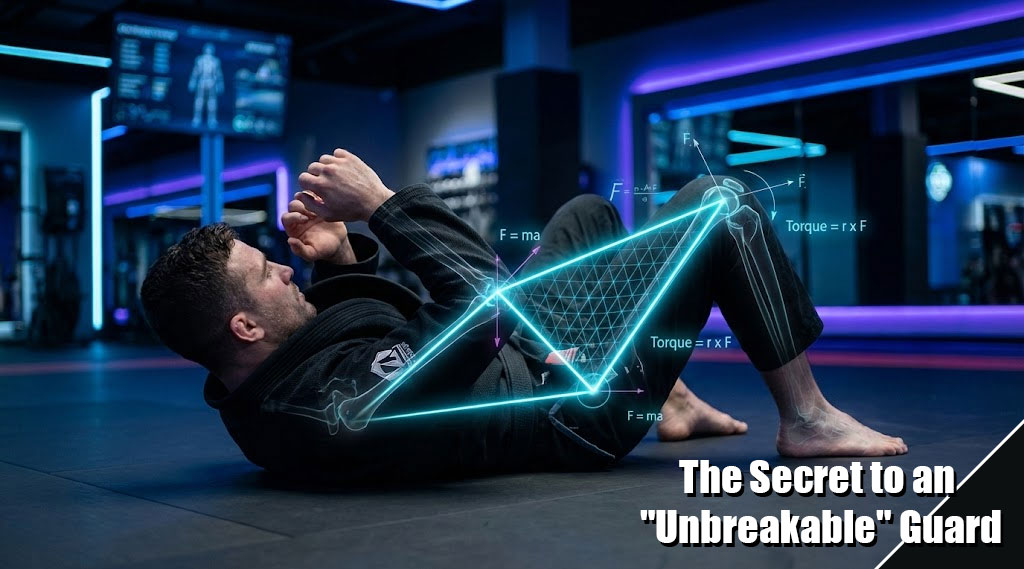
Decoding the “Elbow-Knee Connection”: The Secret to an “Unbreakable” Guard
Have you ever wondered why the black belts or coaches at BJJ Bangkok seem to have an invisible force field around them?
No matter how hard you push, run around, or attempt to jump over their guard, they always manage to put a leg back in front of you. Conversely, when you play guard, it often feels like your front door is wide open, inviting everyone to smash you.
The problem isn’t your strength or your speed. The problem is your Structure.
In the world of Brazilian Jiu-Jitsu, there is a golden rule that separates beginners from pros: Space Management. And the most powerful tool to close that space is what we are discussing today.
This article is a deep dive into the “Elbow-Knee Connection”: The Secret to an Unbreakable Guard. This is a core pillar of the Marcelo Silva Martial Arts curriculum, designed to turn your defense into an impenetrable fortress.
The Science Behind the "Elbow-Knee Connection"
Defining Connection: More Than Just Touching
The “Elbow-Knee Connection” isn’t just about physically touching your elbow to your knee. It is about creating a Frame that connects your upper body (elbow/arm) and lower body (knee/leg) to close the “Inside Space” around your abdomen and hips.
Why close this space? Because the goal of passing the guard in any form of Grappling (Wikipedia) is to occupy the space between your elbow and knee. If an opponent can wedge their shoulder or knee into this gap, your defensive structure collapses instantly.
Biomechanics
When your elbow and knee are connected, you create the strongest possible biomechanical structure:
-
-
Reduced Muscular Load: You don’t rely on arm strength to push the opponent away; you use your skeletal structure to bear their weight.
-
Core Activation: This posture forces your core muscles to activate automatically, making every movement more efficient.
-
Rotation: When your body is connected as a single unit, you can spin or “Shrimp” much faster than if your limbs are flailing independently.
-
The "Elbow-Knee Connection" in Action
At BJJ Bangkok, we emphasize that theory must translate to reality. Here is how to apply this concept in three critical scenarios:
1. Side Control Defense (Survival Mode)
This is where white belts fail the most! When you are crushed under Side Control, do not try to “hug” the opponent.
-
The Action: Pull your bottom elbow to your hip and bring your bottom knee up to meet it. Connect them firmly.
-
The Result: You create a “wall” that prevents the opponent from fully settling on your chest. This wall is what you use to push off and recover your guard.
2. Defending the Knee-Cut Pass
This happens when an opponent tries to slice their knee across your body to pass.
-
The Action: Use your elbow to “frame” against their knee and your own knee to “frame” against their shoulder. Maintain this structure.
-
The Result: The opponent cannot collapse the distance because they are hitting the solid frame of the Marcelo Silva Martial Arts concept.
3. Mount Defense
If you let your elbows flare away from your knees, the opponent will slide up into a “High Mount,” making escape nearly impossible.
-
The Action: Keep your elbows tight to your ribs and constantly pull your knees up towards your elbows.
-
The Result: This forces the opponent to stay in a “Low Mount” on your hips, making it much easier for you to Bridge (Upa) and escape.
Why is This the Heart of Marcelo Silva Martial Art?
The philosophy of Marcelo Silva Martial Arts does not teach you to fight with brute force, but with efficiency.
-
Safety First: Keeping limbs compact drastically reduces the chance of injury from isolation submissions like Armbars (Wikipedia) or Kimuras.
-
Longevity: This technique requires less energy, allowing you to practice Brazilian Jiu-Jitsu well into old age.
-
Foundation for Offense: When your defensive connection is solid, your attacks become sharper because your base is secure.
At BJJ Bangkok, we see students make a quantum leap in skill the moment they truly “get” this concept. It’s like unlocking a secret level in the game.
Drills to Forge an Iron Guard
To truly master the Elbow-Knee Connection, try these specific drills:
The Shell Drill
-
Lie on your back, knees up.
-
Pull both elbows to touch your thighs or knees (The Shell).
-
Have a partner walk around you, trying to touch your chest or stomach.
-
Your Goal: Do not use your hands to grab! Use only hip movement and maintain the elbow-knee connection to block them.
Wall Drill
Lie on your side with your back against a wall. Practice bringing your bottom knee and bottom elbow together, then push off the wall to move your hips away. This simulates a perfect Side Control escape movement.
Conclusion: Lock Your Doors
Your guard doesn’t “break” because the opponent is too good; it breaks because you left the “door” (the gap between elbow and knee) open.
By decoding the Elbow-Knee Connection today, you have taken the first step from being a “victim” to being a “controller.” Remember, Martial Arts is about details.
If you want to practice these techniques in a safe and professional environment, we invite you to experience the systematic method at BJJ Bangkok. We are ready to help you build your own unbreakable guard.
“Give them zero space, for that is where defeat begins.”
Frequently Asked Questions (FAQ)
Q1: Does the Elbow-Knee Connection need to physically touch all the time? A: Not necessarily touching physically every second, but the “structure” must be close enough that no arm or leg can wedge between them. If you extend to attack, you must immediately snap back to connection.
Q2: Does this concept apply to No-Gi? A: Absolutely, and perhaps even more so! In No-Gi (without the kimono), the game is very slippery. Using skeletal structure to block is far more effective than trying to hold on with grips.
Q3: If I am not flexible, can I do this? A: Yes. This concept relies on proper hip mobility, not yoga-like flexibility. At BJJ Bangkok, we include drills to help beginners improve this specific mobility.
Q4: Why do I still get passed even when trying to connect? A: Usually, it happens during a transition lapse, or the opponent uses pressure to force the connection open. The fix is to “Re-guard” or hip escape to create fresh space before re-establishing the connection.
Q5: How does this prevent injury? A: Keeping limbs compact prevents them from being hyperextended and reduces the chance of an opponent dropping their weight on a weak, isolated joint.
Q6: Where can I start learning this in Bangkok? A: You can learn and practice this at BJJ Bangkok (BJJBKK). We offer fundamental classes taught by experts who will help correct your posture from day one.
การฝึก Brazilian Jiu Jitsu in Bangkok เป็นการลงทุนที่คุ้มค่าในตัวคุณเอง ทั้งด้านร่างกาย จิตใจ และทักษะการป้องกันตัว หากคุณหลีกเลี่ยงข้อผิดพลาดข้างต้น และฝึกฝนอย่างต่อเนื่อง คุณจะพัฒนาตัวเองอย่างก้าวกระโดดแน่นอน
At BrazilianJiuJitsuBKK.com, we welcome students of all levels. Our experienced instructors, international community, and central Bangkok location make us the ideal place to begin or continue your Brazilian Jiu Jitsu journey.

 ไทย
ไทย  English