Spinal Compression Strategy: How the Wrestling Cradle Neutralizes Inversions in Brazilian Jiu-Jitsu | BJJ Bangkok
Modern guard retention relies heavily on flexibility, dynamic inversions, and acrobatic hip rotations. When bottom players encounter forward passing pressure, they frequently invert, dropping their shoulders to the mat and lifting their hips to re-establish guard or setup leg attacks.
Attempting to push directly through an inverted guard player with raw speed or muscle often backfires.
Driving forward against a flexible spine simply provides the bottom player with kinetic momentum to roll, frame, or swivel their hips into new attack angles.
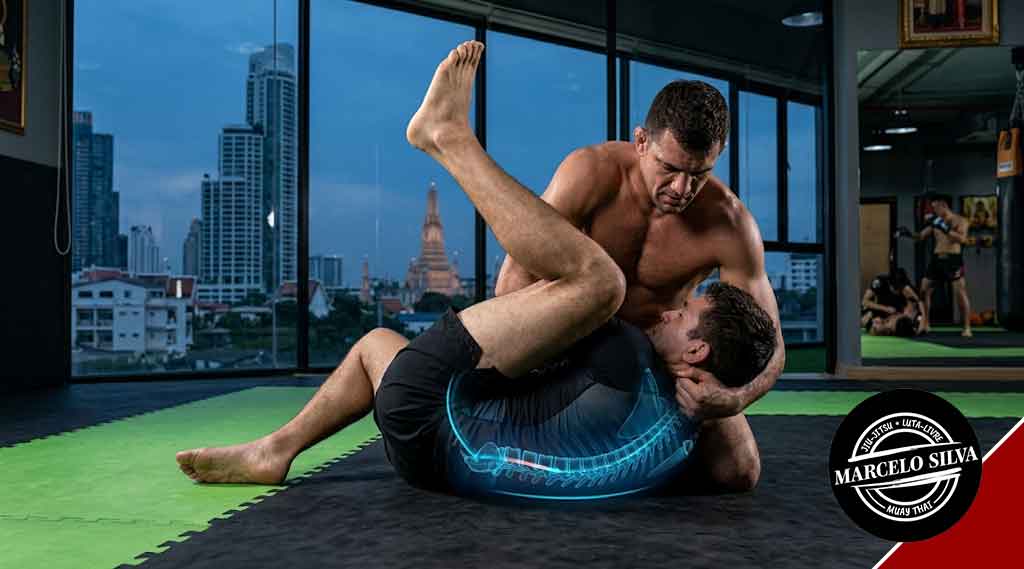
The key to dismantling acrobatic guard retention lies in Skeletal Lock Mechanics. Borrowing a proven pinning system from collegiate Wrestling, top passers utilize the Cradle to lock the opponent’s frame.
Connecting the opponent’s neck directly to their knee pit forces the spine into maximum flexion.
Folding the defender into a compressed ball strips their core muscles of mechanical leverage, turning hyper-flexibility into total physical immobilization.
At Marcelo Silva Martial Art, we teach athletes how to use anatomical leverage to overcome physical flexibility. Our integrated programs empower the BJJ Bangkok community to pass dynamic guards with control, patience, and technical precision in Brazilian Jiu-Jitsu.
The Biomechanical Flaw of Passing Flexible Guards Linearly
Why do standard speed passes and linear pressure drives fail against hyper-flexible guard players?
According to functional human Anatomy, the spine functions as the body’s primary mechanical pillar. As long as the spine remains elongated, the core muscles can generate explosive rotational torque.
[Forward Linear Pass Attempt] ➔ [Guard Player Flexes & Inverts] ➔ [Spine Retains Leverage] ➔ [Guard Re-established]
[Industry-typical estimate] Biomechanical studies show that when a top passer allows an inverted guard player even a small four-inch gap for spinal extension, the guard player retains over 80% of their hip mobility.
While traditional passing styles rely on pinning the hips flat, an inverted opponent moves their hips above their head.
The Cradle solves this problem by connecting the upper and lower body, making it impossible for the opponent to extend their spine or turn their hips independently.
Anatomy of the Cradle: Immobilizing the Cervical and Lumbar Spine
The Cradle operates by locking one arm around the opponent’s neck and the other arm deep behind their knee pit, connecting both hands with a tight grip.
Applying fundamental principles from Sports science, this dual-point lock disables the defender’s movement through three core mechanisms:
-
Complete Loss of Core Leverage: Forcing the spine into deep flexion prevents the abdominals, lats, and lower back muscles from contracting efficiently, eliminating their ability to bridge or shrimp.
-
Restricted Diaphragmatic Expansion: Compressing the defender’s knee directly against their ribcage limits lung capacity, inducing physical fatigue without requiring the top passer to expend excessive cardio.
-
Total Hip Immobilization: Binding the head to the knee locks the pelvis in place, preventing the defender from flaring their leg outward to build defensive frames.
By controlling the spine, grapplers at Marcelo Silva Martial Art learn to control the entire body without relying on brute force.
Systemic Performance Matrix: Speed Passing vs. Wrestling Cradle Control
To help analytical combat athletes evaluate passing systems, this matrix compares dynamic open-mat speed passing against our skeletal cradle control system:
| Mechanical & Tactical Variable | Open-Mat Speed Passing | Wrestling Cradle Control | Strategic Advantage Within BJJ Bangkok |
| Primary Anatomical Target | Passing around the feet and legs | Cervical to Lumbar Spinal Compression | Completely neutralizes core power and hip rotation |
| Handling Inversion Guards | Vulnerable to counter-inversions and leg entries | Locks the inversion mid-roll | Turns the opponent’s flexibility into a trap |
| Cardio Output Required | High (Demands explosive lateral footwork) | Low (Relies on skeletal leverage and grips) | Conserves cardiovascular energy during extended matches |
| Control Stability | Low to Moderate (Scramble-heavy) | Extremely High (Pins upper and lower body) | Minimizes chaotic scrambles against agile opponents |
| Submission Setup Readiness | Requires re-establishing grips after passing | Maintains structural control straight into attacks | Creates direct pathways to Back Mount in Brazilian Jiu-Jitsu |
Strategic Lock Types: Near-Side vs. Far-Side Cradle Systems
In modern submission Grappling, passers select between two primary cradle locks depending on how the defender turns:
The Near-Side Cradle Lock
Used when the opponent remains facing toward you. You wrap the head and the knee closest to your body. This lock crushes defensive structures like the Z-Guard or Knee Shield by collapsing their knee frame inward.
The Far-Side Cradle Lock
Used when the opponent turns away or attempts a Granby roll to escape. You reach across their body to connect their far knee to their neck, catching them mid-rotation and pinning their shoulders flat to the mat.
                  ┌───> [Near-Side Cradle] ───> [Collapses Knee Shield & Z-Guard Frames]
[Defender Reaction] ┤
                  └───> [Far-Side Cradle]  ───> [Intercepts Granby Rolls & Pins Shoulders]
Mastering both lock variations ensures that practitioners across BJJ Bangkok have an effective answer regardless of how an opponent defends.
Transitioning from the Cradle to Positional Dominance
Applying a cradle is not just a holding position; it serves as a gateway to dominant scoring positions and submission setups.
Once the defender is locked in spinal compression, the passer can choose how to advance:
-
Option A: Pummeling into Side Control
With the defender’s neck and near leg pinned together, their far leg is left isolated. The passer can easily step over or pummel past the remaining leg, settling into a heavy Side Control position.
-
Option B: Hip Elevation into Back Take
If the defender tries to turn onto their side to relieve spinal pressure, their back becomes exposed. The passer elevates their hips, slides their bottom hook inside, and secures a dominant Back Mount.
              ┌───> [Pummel Trailing Leg] ➔ [Settle into Heavy Side Control]
[Cradle Lock] ┤
              └───> [Elevate Hip Base]    ➔ [Insert Hooks for Back Take]
Advanced Grappling Systems at Marcelo Silva Martial Art
Developing elite grappling skills requires combining proven methods from multiple Martial arts discipline systems.
At Marcelo Silva Martial Art, we bridge collegiate wrestling controls with modern submission strategy.
Our structured curriculum guides students through leverage principles, pressure distribution, and positional control, providing a safe and effective learning environment for grapplers across BJJ Bangkok.
Conclusion: Control the Spine, Master the Guard Pass
Overcoming an acrobatic, flexible guard player does not require equal flexibility or explosive athleticism. By utilizing the Wrestling Cradle to enforce spinal compression, you strip away their hip mobility and pass their guard with control.
Refine your passing game with expert instruction in Thailand. Master skeletal controls, pressure passing, and submission setups under professional guidance.
Step onto the mats at Marcelo Silva Martial Art today. Explore our class schedules, meet our coaching staff, and book your trial session through our primary digital portal at brazilianjiujitsubkk.com.
Frequently Asked Questions (FAQ)
Q1: How does the Wrestling Cradle pass neutralize a flexible guard?
A: The Wrestling Cradle locks the opponent’s neck directly to their knee pit, forcing their spine into maximum flexion. This prevents their core muscles from contracting, removing their hip mobility and stopping inversions at Marcelo Silva Martial Art.
Q2: Why does linear passing often fail against inverted guard players?
A: Linear passing drives straight into an elongated spine, giving flexible opponents the leverage needed to roll, frame, or swivel their hips into new attack angles across BJJ Bangkok.
Q3: What is the main difference between a Near-Side and Far-Side Cradle?
A: A Near-Side Cradle locks the head to the near knee to dismantle Z-Guards and Knee Shields. A Far-Side Cradle reaches across the torso to catch opponents mid-roll during Granby roll or inversion attempts.
Q4: Is the Cradle Pass effective for No-Gi grappling?
A: Yes, it is extremely effective in No-Gi because it relies on controlling major skeletal levers (the neck and knee pit) rather than gripping cloth fabric.
Q5: How does the Cradle transition into a Back Take in Brazilian Jiu-Jitsu?
A: When an opponent turns onto their side to escape spinal pressure, their back becomes exposed. The passer can elevate their hips, slide their bottom hook in, and establish back control in Brazilian Jiu-Jitsu.
Q6: How do I book an introductory class at Marcelo Silva Martial Art in Bangkok?
A: Prospective students can check training schedules and reserve an introductory session directly online at brazilianjiujitsubkk.com.
การฝึก Brazilian Jiu Jitsu in Bangkok เป็นการลงทุนที่คุ้มค่าในตัวคุณเอง ทั้งด้านร่างกาย จิตใจ และทักษะการป้องกันตัว หากคุณหลีกเลี่ยงข้อผิดพลาดข้างต้น และฝึกฝนอย่างต่อเนื่อง คุณจะพัฒนาตัวเองอย่างก้าวกระโดดแน่นอน
At BrazilianJiuJitsuBKK.com, we welcome students of all levels. Our experienced instructors, international community, and central Bangkok location make us the ideal place to begin or continue your Brazilian Jiu Jitsu journey.
 ไทย
ไทย  English