Asymmetrical Reach Defense: Deconstructing Pocket Interception and 4oz Tactics at ONE Friday Fights 165 | BJJ Bangkok
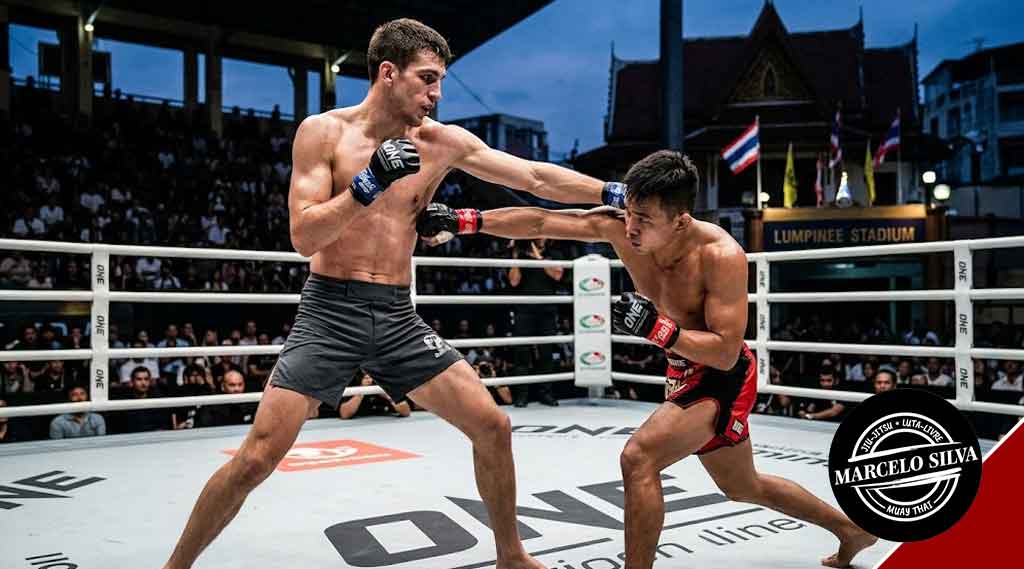
The highly anticipated ONE Friday Fights 165 event at the historic Lumpinee Boxing Stadium in Bangkok serves as the ultimate proving ground for modern combat sports biomechanics.
The stylistic clashes featuring towering tacticians like Nabil Anane against aggressive power punchers like Sueakim, alongside the technical brilliance of Superlek facing Abdulla Dayakaev, present a perfect case study in Asymmetrical Reach Defense.
These matchups contrast two foundational philosophies in combat: maintaining a defensive perimeter using extreme skeletal length versus utilizing blind spot exploitation and pocket interception to collapse the distance.
Understanding how to bypass a physical reach disadvantage and transition those entries directly into dominant grappling controls is a core pillar of the curriculum at Marcelo Silva Martial Art.
For our BJJ Bangkok community, dissecting the spatial geometry of Muay Thai translates directly into higher Fight IQ, bridging the gap between standing striking and world-class Brazilian Jiu-Jitsu.
The Anatomic Barrier of Asymmetrical Reach
Athletes like Nabil Anane possess extreme skeletal length, which they weaponize to create an anatomic barrier.
According to fundamental principles of human Anatomy, a fighter with a significant reach advantage controls the outer perimeter, forcing the shorter opponent to exhaust their energy just to step into a viable striking range.
[Long-Limbed Defender] ➔ (Teep / Straight Knee Perimeter) ➔ [No-Entry Zone] ➔ [Shorter Opponent Blocked]
By constantly framing with long straight knees and front kicks, the taller fighter prevents the aggressive puncher from planting their feet.
This asymmetrical reach creates a scenario where the shorter fighter must absorb damage merely to close the gap, making linear attacks highly inefficient.
Blind Spot Exploitation and Pocket Interception
To neutralize a massive reach advantage, a shorter fighter cannot afford to step straight forward into the opponent’s strongest weapons. The solution relies on Blind Spot Exploitation and stepping off the centerline.
Leveraging concepts from Sports science, the safest way to enter the “pocket” (the close-quarters striking range) against a taller fighter involves lateral stepping to the outside of their lead foot.
[Opponent's Linear Centerline]
               │
               ▼
[Shorter Fighter] ➔ (Lateral Step to Outside Foot) ➔ [Blind Spot Entry] ➔ [Close Quarters Clinch]
This lateral entry provides three distinct biomechanical advantages:
-
Vector Evasion: Moving to the outside angle forces the taller fighter’s straight punches and knees to sail past the shoulder, nullifying their primary defensive frames.
-
Rotational Lag: The taller opponent must pivot their hips to face the new angle, creating a split-second delay in their reaction time.
-
Clinch Integration: Arriving at the blind spot places the shorter fighter in the perfect position to bypass the arms and secure a body lock, transitioning seamlessly into Mixed martial arts takedowns or Brazilian Jiu-Jitsu control positions.
At Marcelo Silva Martial Art, our instructors drill these specific pocket entry mechanics, ensuring athletes across BJJ Bangkok can confidently close the distance against larger training partners.
Systemic Performance Matrix: Linear Retreat vs. Angular Pocket Entry
To assist analytical combat athletes in evaluating distance closing systems, this matrix compares traditional straight-line entries against our angular pocket interception protocol:
| Mechanical & Tactical Variable | Linear Straight-Line Entry | Angular Pocket Interception | Strategic Advantage Within BJJ Bangkok |
| Spatial Objective | Marching straight into the opponent’s guard | Stepping laterally to the opponent’s blind spot | Bypasses the anatomic barrier of taller fighters |
| Defensive Exposure | Extremely High (Walks into straight knees/teeps) | Low (Head moves off the centerline) | Drastically reduces absorbed damage during entries |
| Target Acquisition | Fights through the opponent’s long arms | Gains direct access to the ribcage and jaw | Maximizes short-range elbow and hook efficiency |
| Clinch & Takedown Continuity | Gets tied up in the opponent’s underhooks | Exposes the opponent’s back for body locks | Connects striking entries directly into Brazilian Jiu-Jitsu |
| Energy Consumption Rate | High (Requires absorbing strikes to move forward) | Moderate (Relies on precise timing and footwork) | Preserves cardiovascular endurance for grappling rounds |
4oz Counter-Striking: The Superlek Timing Paradigm
In ONE Championship’s 4oz small glove format, fighters cannot rely on shelling up behind thick padding to absorb strikes. Fights at this level are dictated by neuromuscular anticipation.
In matchups like Superlek vs. Dayakaev, victory belongs to the fighter who reads telegraphing motions and intercepts the opponent mid-strike.
[Industry-typical estimate] Combat analytics demonstrate that in 4oz gloves, intercepting an opponent while they are mid-strike carries up to a 40 percent higher knockout probability.
Because the opponent’s defensive posture inherently opens up when they launch an attack, sharp counter-strikers slip the initial movement and land devastating hooks in the pocket.
This acute timing translates directly to elite Grappling, allowing practitioners to time their takedown shots perfectly as the opponent overcommits.
Bridging the Pocket into Brazilian Jiu-Jitsu
A successful pocket entry does more than set up short elbows; it serves as the ultimate gateway into ground dominance.
Once a fighter slips to the outside blind spot and crashes the distance, the taller opponent’s reach advantage is completely neutralized.
From this close-quarters position, martial artists trained at Marcelo Silva Martial Art immediately capitalize on the structural advantage:
-
The Rear Body Lock: Wrapping the arms securely around the opponent’s waist from the side angle to break their posture.
-
The Mat Return: Utilizing hip leverage to sweep the opponent’s base and bring the fight to the canvas.
-
Submission Control: Bypassing the guard entirely to secure a dominant Back Mount or Side Control position.
Master Asymmetrical Reach Defense at Marcelo Silva Martial Art
High-level fight cards like ONE Friday Fights 165 prove that physical disadvantages can be completely overcome by superior Fight IQ and biomechanical strategy.
At Marcelo Silva Martial Art, we are dedicated to teaching these sophisticated combat mechanics to practitioners of all levels.
By integrating the precise footwork of Muay Thai with the leveraging power of Brazilian Jiu-Jitsu, our BJJ Bangkok community develops a complete, well-rounded combat system capable of dismantling any opponent.
Conclusion: Turn Reach Disadvantages into Clinch Opportunities
Facing a much taller opponent with a massive reach advantage can feel overwhelming, but it is a puzzle that biomechanics can solve. By mastering blind spot exploitation and pocket interception, you turn your opponent’s length into a liability, securing dominant angles for strikes and takedowns.
Elevate your technical skills and train with science-backed methodologies in Thailand. Learn how to cut angles, intercept timing, and dominate the clinch under expert guidance.
Step onto the mats at Marcelo Silva Martial Art today. View our training schedules, meet our coaching staff, and book your introductory trial session through our portal at brazilianjiujitsubkk.com.
Frequently Asked Questions (FAQ)
Q1: How do shorter fighters overcome a massive reach advantage in Muay Thai?
A: Shorter fighters overcome reach by stepping laterally off the centerline to enter the opponent’s blind spot. This angular movement bypasses long straight knees and kicks, allowing safe entry into the close-quarters pocket at Marcelo Silva Martial Art.
Q2: What is pocket interception in 4oz glove combat sports?
A: Pocket interception is the tactic of reading an opponent’s telegraphing motion and slipping inside their strike to counter them at close range. In 4oz gloves, this is highly effective because you cannot safely absorb strikes using a traditional high guard across BJJ Bangkok.
Q3: Why is stepping straight forward dangerous against a tall fighter?
A: Stepping linearly plays directly into a tall fighter’s anatomic barrier. It forces you to absorb their teeps and straight knees, accelerating muscle fatigue and drastically increasing the risk of taking severe damage before landing a strike.
Q4: How does entering the blind spot lead to a Brazilian Jiu-Jitsu takedown?
A: By stepping to the outside of the opponent’s lead foot, you gain access to their side and back. From this dominant angle, you can safely secure a rear body lock and execute a mat return into Brazilian Jiu-Jitsu ground control.
Q5: Can I practice these lateral pocket entries safely as a beginner?
A: Yes. At Marcelo Silva Martial Art, beginners focus heavily on isolated footwork drills and head movement on the pads before applying the techniques against live, taller training partners.
Q6: How can I register for striking and grappling programs in Bangkok?
A: Prospective students can check training schedules and reserve an introductory session directly online at brazilianjiujitsubkk.com.
การฝึก Brazilian Jiu Jitsu in Bangkok เป็นการลงทุนที่คุ้มค่าในตัวคุณเอง ทั้งด้านร่างกาย จิตใจ และทักษะการป้องกันตัว หากคุณหลีกเลี่ยงข้อผิดพลาดข้างต้น และฝึกฝนอย่างต่อเนื่อง คุณจะพัฒนาตัวเองอย่างก้าวกระโดดแน่นอน
At BrazilianJiuJitsuBKK.com, we welcome students of all levels. Our experienced instructors, international community, and central Bangkok location make us the ideal place to begin or continue your Brazilian Jiu Jitsu journey.

 ไทย
ไทย  English