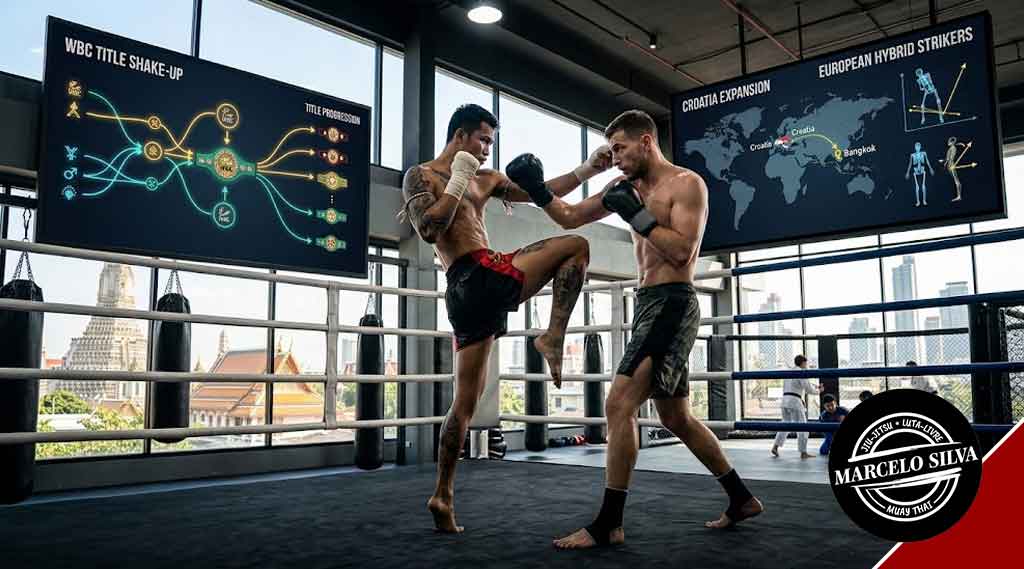
Muay Thai: WBC Title Shake-Up, Croatia Expansion, and the Rise of European Hybrid Strikers | BJJ Bangkok
Late August 2026 has delivered a massive structural shift to the international combat sports community. The World Boxing Council (WBC) MuayThai has confirmed two major administrative developments that will ripple through the welterweight division and international striking circuits.
Irish standout Niall McGreevy has officially vacated his WBC World Welterweight title to fulfill championship defense obligations in other global promotions. In a parallel move aimed at international growth, WBC MuayThai has appointed Srdan Spirk as the official representative for Croatia, planting a firm flag in the Balkan Peninsula.
Deconstructing these moves reveals the modern realities of professional fight management and the evolution of regional combat styles. At Marcelo Silva Martial Art, analyzing these international trends allows practitioners to decode elite tactical behaviors. Bridging the gap between European striking pressure and the dominant ground control of Brazilian Jiu-Jitsu equips athletes in Bangkok with a truly global Fight IQ.
1. The Anatomy of a Vacated Title: Niall McGreevy’s Strategic Move
Niall McGreevy’s decision to relinquish the WBC Welterweight strap is a prime example of intelligent athletic load management. Navigating the modern combat sports ecosystem requires athletes to balance contractual obligations with physical preservation.
According to principles of Sports science, the welterweight division (147 lbs / 66.7 kg) demands extreme metabolic conditioning. Fighters in this weight class cannot afford rapid, continuous weight cuts without suffering severe physiological consequences.
[Industry-typical estimate] Analytical data from international combat organizations suggests that champions who attempt to defend multiple belts across different promotions suffer a 45% increase in overtraining syndrome and severe joint injuries. By vacating the title, McGreevy avoids excessive dehydration cycles, preserving his central nervous system and ensuring long-term career longevity.
2. Eastern European Expansion: The Croatian Hybrid Striker
The appointment of Srdan Spirk to lead WBC MuayThai in Croatia marks a highly strategic expansion into Eastern Europe. This region is a historic hotbed for power strikers, and merging it with traditional eight-limb combat creates a dangerous new archetype.
The Balkans possess a deep lineage of Dutch-style Kickboxing. When athletes from this region adopt traditional Muay Thai rules, they evolve into “Hybrid Strikers.” This profile is highly aggressive and relies on specific biomechanical weapons:
Relentless Pocket Boxing: Utilizing heavy, high-volume body-and-head hook combinations to force opponents into a defensive shell.
Integrated Short Elbows: Slipping vertical and horizontal elbows directly into the middle of boxing combinations, catching opponents off guard at close range.
Muscular Framing: Relying on dense upper-body strength to frame against the opponent’s collarbones and neck, breaking posture through physical force rather than traditional plum technique.
Converting European Striking Pressure into Submission Grappling
For martial artists, understanding how to neutralize the forward pressure of European welterweight strikers is critical. When faced with high-volume pocket boxing, retreating linearly is a tactical error that leads to being trapped against the ropes or cage.
The most effective countermeasure bridges the gap directly into Mixed martial arts and grappling.
The Biomechanical Sequence: [Opponent Blitzes with Hooks] ➔ [Execute 45-Degree Lateral Slip] ➔ [Pummel for Inside Underhook] ➔ [Transition to Body Lock]
By stepping off the centerline at a 45-degree angle, a defender creates a spatial void. This allows them to bypass the striking combinations and secure a dominant underhook. From this position, initiating a mat return brings the fight to the canvas, where positional hierarchies in submission grappling dictate the outcome.
Strategic Matrix: Traditional vs. European Combat Dynamics
| Tactical Dimension | Traditional Thai Meta | European / Balkan Meta | Mat Application Strategy |
| Pacing & Pressure | Calculated rhythm and single power strikes | High-volume blitzing and forward pressure | Utilize lateral movement to evade straight-line attacks |
| Clinch Strategy | Hip sweeps and technical posture breaking | Forearm framing and short-range elbows | Secure underhooks to transition into body lock takedowns |
| Stance & Footwork | Rear-foot heavy for rapid kick checking | Pendulum stepping for fast pocket entries | Exploit the widened stance with well-timed inside trips |
Elevate Your Global Fight IQ in Thailand
The global expansion of combat sports means that modern athletes must be prepared to face a variety of regional styles, from traditional Thai tacticians to heavy-handed European hybrid strikers. Understanding distance management, fight load preservation, and the physics of the clinch is essential for long-term success.
Marcelo Silva Martial Art provides a world-class training environment that dissects these international combat trends. By fusing the biomechanics of elite striking with the intricate control systems of submission grappling, the curriculum ensures that students develop a robust, cross-disciplinary skill set.
Prepare to adapt to any combat scenario. Step onto the mats and master the connection between stand-up defense and elite ground control by joining the premier Brazilian Jiu-Jitsu and MMA programs at Marcelo Silva Martial Art in BJJ Bangkok today.
Frequently Asked Questions (FAQ)
Q1: What major title news recently came out of the WBC MuayThai organization?
A: Irish fighter Niall McGreevy officially vacated his WBC World Welterweight title to manage his demanding fight schedule and fulfill championship defense obligations in other global promotions.
Q2: Why is the WBC MuayThai expansion into Croatia significant?
A: The appointment of Srdan Spirk as the representative for Croatia signals a massive push into the Balkan Peninsula, a region famous for producing incredibly powerful, boxing-heavy strikers.
Q3: What characterizes the European “Hybrid Striker” style?
A: This style blends the heavy, high-volume punch combinations of Dutch kickboxing with the short elbows and upper-body framing allowed in traditional eight-limb striking, creating a highly aggressive inside fighter.
Q4: How does a fighter defend against aggressive pocket boxing?
A: Instead of retreating backward, a fighter should use 45-degree lateral footwork to slip the punches. This takes them off the centerline and creates an opening to counter-strike or secure a clinch.
Q5: How does lateral footwork translate to Brazilian Jiu-Jitsu takedowns?
A: Slipping a punch at an angle places you on the outside of the opponent’s arms, providing a direct pathway to secure an underhook and a body lock, which are essential grips for executing a takedown.
Q6: Why is fight load management crucial for professional fighters?
A: Frequent weight cutting and constant high-impact competition increase the risk of severe dehydration, joint injuries, and overtraining. Managing the fight load ensures an athlete can sustain a long, healthy career.
Q7: Where can I learn to mix striking defense with grappling in Bangkok?
A: You can master these modern combat transitions by booking a trial class at Marcelo Silva Martial Art. Visit brazilianjiujitsubkk.com to explore the schedule and join the elite training community in BJJ Bangkok.
การฝึก Brazilian Jiu Jitsu in Bangkok เป็นการลงทุนที่คุ้มค่าในตัวคุณเอง ทั้งด้านร่างกาย จิตใจ และทักษะการป้องกันตัว หากคุณหลีกเลี่ยงข้อผิดพลาดข้างต้น และฝึกฝนอย่างต่อเนื่อง คุณจะพัฒนาตัวเองอย่างก้าวกระโดดแน่นอน
At BrazilianJiuJitsuBKK.com, we welcome students of all levels. Our experienced instructors, international community, and central Bangkok location make us the ideal place to begin or continue your Brazilian Jiu Jitsu journey.


 ไทย
ไทย  English