Brazilian Jiu-Jitsu: Mastering the Anti-Stalling Meta for the Pan and World No-Gi Championships | BJJ Bangkok
As mid-September 2026 arrives, the global grappling community is officially on notice. The International Brazilian Jiu-Jitsu Federation (IBJJF) has opened registrations for the Pan No-Gi Championship in October and the prestigious World No-Gi Championship in December. Consequently, elite training camps worldwide have shifted from offseason drilling into intense, tactical peak preparation.
The focal point of these world-class training camps is adapting to the modern IBJJF ruleset, which aggressively penalizes passive play and stalling. To capture gold on the world stage, athletes are abandoning traditional, static guard retention in favor of relentless forward pressure, wrestling integrations, and dynamic submission chaining.
Understanding these global tactical shifts is essential for any modern martial artist. Marcelo Silva Martial Art translates these cutting-edge strategies from the world’s best camps directly into its curriculum, ensuring that practitioners in the BJJ Bangkok community are equipped to dominate in any Brazilian Jiu-Jitsu environment.
1. The Wrestle-Jitsu Evolution: Punishing the Guard Pull
The most significant shift in the 2026 No-Gi meta is the strict enforcement of anti-stalling penalties, specifically targeting the double guard pull. When two competitors sit down simultaneously and fail to initiate a sweep or attack within seconds, the referee will intervene and penalize both athletes.
To bypass this risk, elite camps are heavily incorporating freestyle Wrestling into their daily regimens:
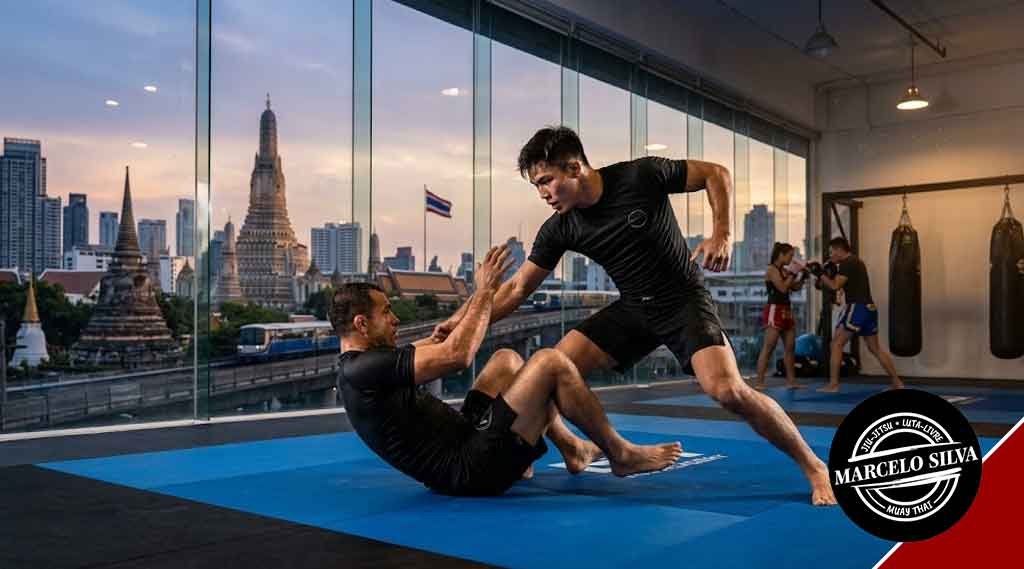
Proactive Top Control: Instead of accepting a bottom position, modern competitors aggressively pursue single and double-leg takedowns to secure the initial two points and dictate the pace from the top.
Wrestling Up: If a competitor finds themselves on the bottom, playing a static guard is no longer viable. They must utilize underhooks and technical stand-ups to “wrestle up,” forcing the top player to defend takedowns rather than pass the guard.
Pace Dictation: By forcing a wrestling-heavy exchange early in the match, an athlete forces their opponent to expend massive amounts of anaerobic energy, draining their cardio for the later minutes of the bout.
2. The Biomechanics of Submission Chaining
With stalling tactics heavily penalized, attempting to win solely by securing minor “Advantage” points is a dangerous gamble. The modern meta demands a high submission finishing rate, which requires an understanding of structural Anatomy.
Rather than hunting for a single, isolated submission, athletes are trained in “Submission Chaining”:
The Offensive Chain Sequence: [Snap Down into Front Headlock] ➔ [Attempt Guillotine Choke] ➔ [Opponent Defends by Exposing the Arm] ➔ [Transition Seamlessly to D’Arce Choke or Anaconda]
This constant threat generation overloads the opponent’s defensive processing. By the time they successfully defend the first attack, the second and third are already locked in. This relentless offensive philosophy is a cornerstone of modern Grappling and requires exceptional fluidity and spatial awareness.
3. Peak Phase Camp Structures: Working Smarter, Not Just Harder
Preparing for the World No-Gi Championship requires a calculated approach to physical exertion. Elite camps do not simply spar at 100% intensity every day; they utilize clinical Sports science to peak the athletes physically and mentally.
Situational Constraints: Rather than free-rolling, coaches place athletes in specific, disadvantageous scenarios (e.g., starting with an opponent fully locked on their back). This builds precise muscle memory for escaping the most dangerous positions in the sport.
Anaerobic Sprints: To prepare for the relentless pacing demanded by the new anti-stalling rules, rounds are structured with short bursts of high intensity followed by minimal rest, mimicking the chaotic scrambles of a real match.
Strategic Tapering: As December approaches, training volume will decrease to allow the central nervous system to fully recover, ensuring athletes enter the tournament with maximum explosive power.
[Industry-typical estimate] Analytical data from international camps suggests that athletes who transition from passive guard play to a proactive, wrestling-heavy top game increase their submission finishing rates by roughly 40% under the current ruleset.
Strategic Comparison Matrix: Adapting to the New Meta
| Tactical Dimension | Traditional No-Gi Strategy | Modern IBJJF No-Gi Meta | Competitive Mat Application |
| Match Opening | Double guard pulls and grip fighting from the knees. | Aggressive takedowns and “Wrestle-Jitsu” entries. | Secure early points and establish dominant top pressure. |
| Positional Focus | Securing a static position and stalling for a narrow victory. | Continuous passing, dynamic movement, and submission chaining. | Overwhelm the opponent’s cardio and defensive frames. |
| Bottom Game | Holding closed guard to neutralize the top player. | Active open guards, leg entanglements, and wrestling up. | Refuse to accept bottom position; constantly threaten sweeps. |
| Transfer to MMA | Guard reliance makes athletes vulnerable to ground-and-pound. | Top-heavy wrestling focus translates perfectly to the cage. | Ideal for functional self-defense in Mixed martial arts. |
Elevate Your Submission Grappling in Bangkok
The global shift toward aggressive, submission-oriented grappling proves that martial arts require constant tactical evolution. Relying on outdated strategies in a modern tournament will result in swift penalties and immediate defeat.
Marcelo Silva Martial Art provides Thailand’s most scientifically advanced and comprehensive martial arts training environment. The academy offers elite instruction in Brazilian Jiu Jitsu, guided by professional coaches in BJJ Bangkok who understand how to decode and apply global meta shifts.
The programs emphasize periodized conditioning, wrestling integrations, and relentless submission chaining. Whether you are aiming to medal in international competition or simply wish to develop a highly functional grappling game, you will find the ultimate blueprint for success. Elevate your technical proficiency by enrolling in specialized Brazilian Jiu Jitsu programs at Marcelo Silva Martial Art in BJJ Bangkok today!
Frequently Asked Questions (FAQ)
Q1: Why is the mid-September period critical for No-Gi competitors?
A: Mid-September marks the opening of registration for the IBJJF Pan No-Gi and World No-Gi championships, signaling elite training camps to transition from offseason drilling into high-intensity, tournament-specific preparation.
Q2: What is the “anti-stalling” meta in modern IBJJF No-Gi?
A: The IBJJF has strictly tightened rules against passive play, particularly double guard pulls. Athletes who fail to advance position or attack are heavily penalized, forcing competitors to adopt a highly aggressive, fast-paced style.
Q3: How does “Wrestle-Jitsu” counter the new ruleset?
A: Wrestle-Jitsu blends freestyle wrestling with BJJ. By proactively hunting for takedowns and establishing top control early, athletes avoid stalling penalties and force their opponents to expend energy defending.
Q4: What is submission chaining?
A: Submission chaining is the practice of linking multiple submission attempts together seamlessly. If an opponent defends a guillotine choke, the attacker instantly transitions to a D’Arce choke or takes the back, overloading the defender’s reaction time.
Q5: Why do elite camps use “situational sparring” instead of free rolling?
A: Situational sparring forces athletes to repeatedly solve specific, high-pressure problems (like escaping a tight submission). This builds targeted muscle memory and reduces the overall risk of injury compared to unstructured free rolling.
Q6: Where can I learn modern No-Gi tactics and Wrestle-Jitsu in Thailand?
A: You can master aggressive takedowns, submission chaining, and elite positional control by booking a trial class at Marcelo Silva Martial Art. Visit brazilianjiujitsubkk.com to explore class schedules and join the premier community in BJJ Bangkok.
การฝึก Brazilian Jiu Jitsu in Bangkok เป็นการลงทุนที่คุ้มค่าในตัวคุณเอง ทั้งด้านร่างกาย จิตใจ และทักษะการป้องกันตัว หากคุณหลีกเลี่ยงข้อผิดพลาดข้างต้น และฝึกฝนอย่างต่อเนื่อง คุณจะพัฒนาตัวเองอย่างก้าวกระโดดแน่นอน
At BrazilianJiuJitsuBKK.com, we welcome students of all levels. Our experienced instructors, international community, and central Bangkok location make us the ideal place to begin or continue your Brazilian Jiu Jitsu journey.


 ไทย
ไทย  English