
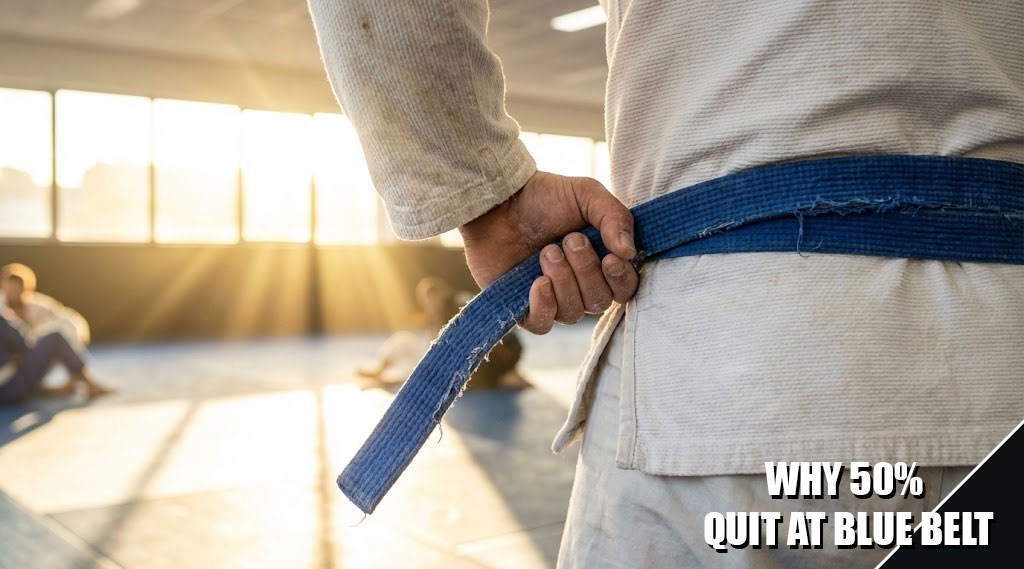
“The Blue Belt Blues”: Why 50% Quit at Blue Belt (And How You Can Survive to Black)
In the world of Brazilian Jiu-Jitsu, there is a statistic that is whispered in every gym: “Most people will quit after receiving their Blue Belt.”
You grind for 1-2 years, surviving the hardships of being a White Belt. Finally, your coach calls your name and ties that blue strap around your waist. It should be a new beginning, but for many, it becomes the end.
This phenomenon is famously known as “The Blue Belt Blues.”
Why does success lead to quitting? Today, we are diving deep into the psychology of why 50% of practitioners vanish at this stage, and how you can use the Marcelo Silva Martial Arts philosophy at BJJ Bangkok to become a survivor.
The Anatomy of Quitting
1. The Target on Your Back
As a white belt, you are the baby of the mats. There are zero expectations. If you lose, it’s normal. If you win, you’re a prodigy.
But the moment you wear blue, the dynamic shifts:
-
White Belts Hunt You: They want the glory of tapping a colored belt to prove they are ready for a promotion.
-
Purple Belts Don’t Hold Back: The “kid gloves” come off. You are now fair game for their A-game.
This pressure transforms training from “fun learning” into “stressful defense of your honor.”
2. The Learning Plateau
At white belt, learning is linear—you learn a new move every day. The progress feels fast.
At blue belt, the curve flattens. This is the phase of Diminishing Returns (Wikipedia). You might train for 3 months and feel like you haven’t improved at all. This “Plateau” is where most people quit, mistakenly believing they have hit their genetic limit.
The Mental Traps
Imposter Syndrome
Many new blue belts feel unworthy. “Did the coach make a mistake?” “I’m not good enough.” This internal doubt, combined with getting smashed by larger white belts, fuels the desire to disappear from the mats to avoid embarrassment.
Comparison is the Thief of Joy
At BJJ Bangkok, we often see students comparing themselves to peers. “Why is he getting stripes faster?” “Why is she tapping me now?” Focusing on others’ journeys instead of your own is the primary fuel for the Blue Belt Blues.
The Survival Guide (Marcelo Silva Martial Art Style)
Here is how to beat the statistics and stay on the path to Black Belt:
1. Shift Goals: From “Belts” to “Skills”
Forget about the Purple Belt. It will come when it comes. Set Micro-Goals instead:
-
“This month, I will master the escape from Side Control.”
-
“This week, I will hit one specific sweep.”
Focusing on small skill acquisitions reignites the dopamine of progress.
2. Accept Defeat in Training
You must accept that getting tapped by a white belt is not fatal. The gym is a laboratory, not a competition arena. If you never lose in training, it means you are playing it too safe and not trying new things.
3. Find Your Tribe at BJJ Bangkok
The power of Community is undeniable. Your teammates at BJJ Bangkok are the ones who pull you back when you feel lazy. Having friends who laugh with you about your mistakes makes the “Blues” manageable.
4. Consistency Over Intensity
Life happens. Work, family, injury. The Golden Rule: Just keep showing up. Even if it’s once a week. Even if it’s just to watch. Consistency beats intensity in the long run.
Conclusion: A Black Belt is a White Belt Who Never Quit
The “Blue Belt Blues” is a test of spirit, not body. It filters out those who are not truly in love with the art.
The Blue Belt is not a trophy; it is a ticket to the real game of Brazilian Jiu-Jitsu. This is the time to find “Your Game.”
Don’t let pressure or boredom stop your potential. At BJJ Bangkok, the Marcelo Silva Martial Arts community is ready to walk this path with you. Remember… the day you receive your Black Belt, you will thank the version of you today that refused to quit.
“The belt covers only 2 inches of your ass. You have to cover the rest.” — Royce Gracie (Wikipedia)
Frequently Asked Questions (FAQ)
Q1: How long does the “Blue Belt Blues” last? A: It varies. It lasts until you shift your mindset from “performing” to “learning.” Once you start enjoying the small details again, the blues fade.
Q2: Can I come back if I quit at Blue Belt years ago? A: Absolutely. At BJJ Bangkok, we welcome returning students all the time. Your body might be rusty, but the muscle memory is there.
Q3: How good should a Blue Belt be? A: A Blue Belt should have solid defense (escapes) and a basic understanding of all major positions. You don’t need to be a wizard; you just need to be safe.
Q4: Do injuries cause people to quit? A: Yes. That’s why we emphasize “Longevity” in our training. Training smart keeps you on the mats.
Q5: Does BJJ Bangkok help with plateaus? A: Yes. Our coaches can analyze your game and prescribe specific Positional Sparring to help you break through barriers.
การฝึก Brazilian Jiu Jitsu in Bangkok เป็นการลงทุนที่คุ้มค่าในตัวคุณเอง ทั้งด้านร่างกาย จิตใจ และทักษะการป้องกันตัว หากคุณหลีกเลี่ยงข้อผิดพลาดข้างต้น และฝึกฝนอย่างต่อเนื่อง คุณจะพัฒนาตัวเองอย่างก้าวกระโดดแน่นอน
At BrazilianJiuJitsuBKK.com, we welcome students of all levels. Our experienced instructors, international community, and central Bangkok location make us the ideal place to begin or continue your Brazilian Jiu Jitsu journey.


 ไทย
ไทย  English