“Plateau Buster”: 3 Ways to Use ‘Positional Sparring’ to Fix Weaknesses 90% of White Belts Have
You’ve been training Brazilian Jiu-Jitsu for six months… maybe a year. You are past the initial “newbie” excitement, but suddenly, you feel… stuck.
You get your guard passed the exact same way every session. You spend 5 minutes crushed under Side Control, unable to escape. You feel like you aren’t improving.
This is what we call “The White Belt Plateau.”
The Problem: You show up and “roll” (free spar) every day, so why aren’t you getting better? The answer—based on our extensive experience at BJJ Bangkok—is simple: Free rolling does not fix your specific weaknesses.
Human nature makes you avoid positions where you are weak. If your guard retention is bad, you instinctively hold on to Closed Guard for dear life. As a result, your open guard never gets tested, and the weakness remains.
The Solution: This article is your “Plateau Buster.” We will introduce Positional Sparring—the single most powerful training method used by world-class coaches and the core of the Marcelo Silva Martial Art philosophy.
Part 1: What is "Positional Sparring" and Why is it Better Than Just "Rolling"?
-
To understand why you are stuck, we must define the three modes of training.
1. Drilling vs. Free Rolling vs. Positional Sparring
-
Drilling: Repetition with zero resistance (e.g., performing an Armbar 20 times). This is great for muscle memory but lacks realism.
-
Free Rolling: Full-contact sparring with no set starting position or goal. This is great for testing your overall game, but bad for fixing specific problems.
-
Positional Sparring: The “bridge” between the two. It is full-contact sparring (100% resistance), but it starts from a specific position with a clear, defined goal.
The Psychology of the Plateau
According to the psychological concept of the Learning Curve (Wikipedia), progress is rapid at first and then flattens out.
Why does Free Rolling cause this plateau? Because of avoidance. If you are terrible at escaping Side Control, you will fight desperately to avoid ending up there. While this is good for survival, it means you never actually spend time practicing the escape against resistance.
The Power of “Deliberate Practice”
Positional sparring is the BJJ equivalent of Deliberate Practice, a concept popularized by psychologist K. Anders Ericsson (Wikipedia).
It forces you to spend 100% of your training time on the exact 10% of your game that is broken. Instead of rolling for 5 minutes and getting your guard passed in minute 4 (giving you only 1 minute of survival practice), you start in the bad position. You spend the entire 5 minutes fixing the problem.
This systematic approach is why elite coaches advocate so strongly for this type of focused training.
-
Part 2: The "Plateau Buster" Blueprint
Fixing the 3 Weaknesses 90% of White Belts Share
We have identified three major “leaks” in the average white belt’s game. Here is how to use Positional Sparring to plug them.
Drill 1: “The Gauntlet” (Fixing The Porous Guard)
The Weakness: You pull guard, but your opponent slices through your legs in seconds. You lack Guard Retention.
The Setup:
-
Partner A (You): Start in a vulnerable guard (e.g., Seated Guard or Open Guard).
-
Partner B (Attacker): Start in a passing stance (standing or kneeling).
The Goal:
-
You: Do not get passed! Retain your guard, sweep, or submit.
-
Attacker: Pass the guard and stabilize for 3 seconds.
The Rules: Go 100%. If they pass, or you sweep/submit, reset immediately to the start.
Why it Works: This drill forces you to use your hips, frames, and leg pummeling instinctively. At BJJ Bangkok, we use this to teach students that the guard is not a static position, but a dynamic battle of distance management.
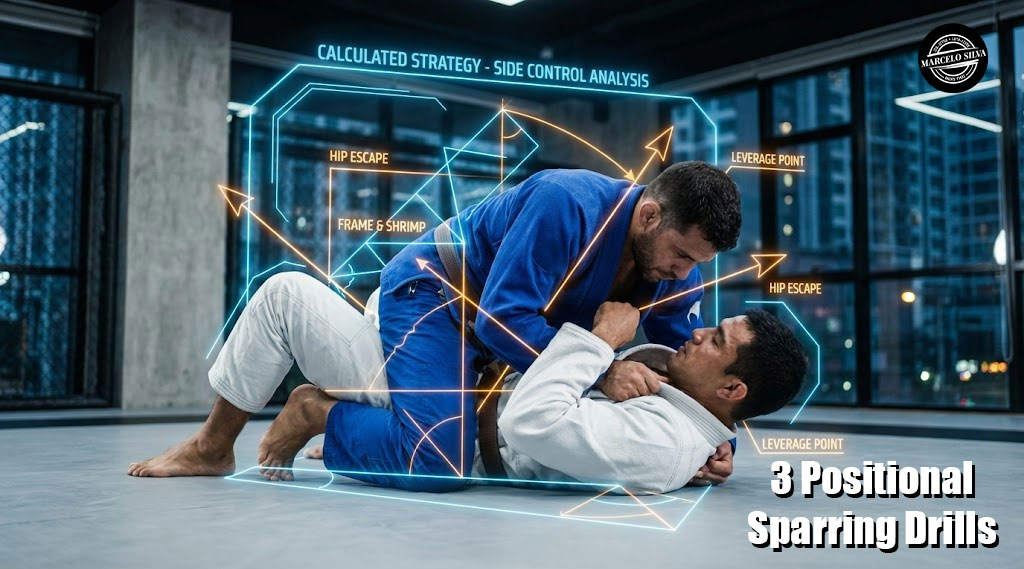
Drill 2: “The Escape Artist” (Fixing The Pinned Survivor)
The Weakness: Once you are passed and stuck in Side Control or Mount, you freeze. You hold your breath and wait for the round to end.
The Setup:
-
Partner A (Attacker): Starts in a fully dominant position (e.g., deep Side Control).
-
Partner B (You): Starts on the bottom, pinned.
The Goal:
-
Attacker: Maintain the pin or submit.
-
You: Escape back to a neutral position (Guard) or reversal.
The Rules: Go 100%. If you escape or get tapped, reset immediately.
Why it Works: This is arguably the most important drill for white belts. It forces you to confront “claustrophobia.” It teaches you to stay calm, breathe, and use technical escapes (like the Bridge and Shrimp) rather than panic strength. This survival-first mindset is a pillar of the Marcelo Silva Martial Art philosophy.
Drill 3: “The Finisher’s Focus” (Fixing The Failed Finisher)
The Weakness: You finally get to a good position (like the Back), but you can’t finish the choke. You lose the position because you can’t break their defensive grips.
The Setup:
-
Partner A (You): Start in a prime attacking position (e.g., Back Control with a seatbelt grip).
-
Partner B (Defender): Starts fully defensive (protecting the neck).
The Goal:
-
You: Finish the submission.
-
Defender: Escape the position.
The Rules: Reset on escape or submission.
Why it Works: It teaches you to solve the “last 10%” of the puzzle. Finishing a resisting opponent requires distinct skills: hand-fighting, trapping arms, and maintaining control pressure simultaneously.
Part 3: Implementation at BJJ Bangkok
How Often Should You Do This?
You shouldn’t replace all free rolling. However, to break a plateau, we recommend spending 10-15 minutes after class grabbing a partner to run these specific drills.
-
Monday: “The Gauntlet” (Guard Retention)
-
Wednesday: “The Escape Artist” (Side Control Escapes)
-
Friday: “The Finisher’s Focus” (Submissions)
The Marcelo Silva Methodology
The Marcelo Silva Martial Art philosophy is not about random training; it is about systematic development.
At our academy, we use Positional Sparring as the standard “bridge” between learning a technique and using it. We don’t just show you a move and say “good luck.” We put you in the position to fail, adjust, and eventually succeed.
This structured environment is what makes our community at BJJ Bangkok so effective at producing skilled grapplers.
Conclusion: Break the Plateau, Don't Wait for It
Hitting a plateau is normal. Staying stuck there is a choice.
Free rolling alone is not the most efficient tool for fixing specific problems. The “Plateau Buster” plan using Positional Sparring is the key. By focusing your intensity on your three biggest weaknesses—Guard Retention, Escapes, and Finishing—you will transform your game faster than you thought possible.
Call to Action: Stop hoping you’ll get better. Start training to get better. If you want to experience a systematic learning environment that uses these exact methods to unlock your potential, visit us at BJJ Bangkok. Our mats are open, and our system is ready for you.
Frequently Asked Questions (FAQ)
Q1: What is the difference between Positional Sparring and Rolling? A: Rolling is a full match with no set start. Positional Sparring is full-resistance fighting that starts from a specific situation (like having your back taken) to practice a specific skill.
Q2: I’m a white belt and my guard always gets passed. Which drill is best? A: Focus on “The Gauntlet” drill mentioned above. Have a higher belt try to pass your guard for 5-minute rounds. It will fast-track your retention skills.
Q3: Does the Marcelo Silva Martial Art philosophy use this method? A: Yes, extensively. We believe in systematic learning. Positional sparring ensures you aren’t just memorizing moves, but learning how to apply them against resistance.
Q4: Where can I learn this type of training in Bangkok? A: You can join us at BJJ Bangkok (BJJBKK). We integrate these concepts into every class to ensure our students progress through their belts with deep technical understanding.
Training Brazilian Jiu Jitsu in Bangkok offers not just physical benefits, but mental and social rewards as well. Avoiding these common beginner mistakes will help you build a solid foundation and enjoy the long-term benefits of BJJ.
At BrazilianJiuJitsuBKK.com, we welcome students of all levels. Our experienced instructors, international community, and central Bangkok location make us the ideal place to begin or continue your Brazilian Jiu Jitsu journey.
 English
  ไทย
ไทย