Angular Footwork Geometry: Escaping Cage Pressure and Neutralizing Wall Wrestling in Brazilian Jiu-Jitsu | BJJ Bangkok
In modern mixed combat sports, the cage wall often becomes a trap for strikers facing heavy, relentless wrestlers. Dedicated wrestlers excel at using linear driving pressure to pin opponents against the fence, shutting down footwork, compressing space, and forcing exhausting ground battles.
Standard defensive tactics—such as leaning back against the pads, static framing, or attempting to sprawl straight back—are physically demanding.
Against an opponent determined to drive forward, static resistance consumes massive metabolic energy and typically delays a takedown rather than avoiding it entirely.
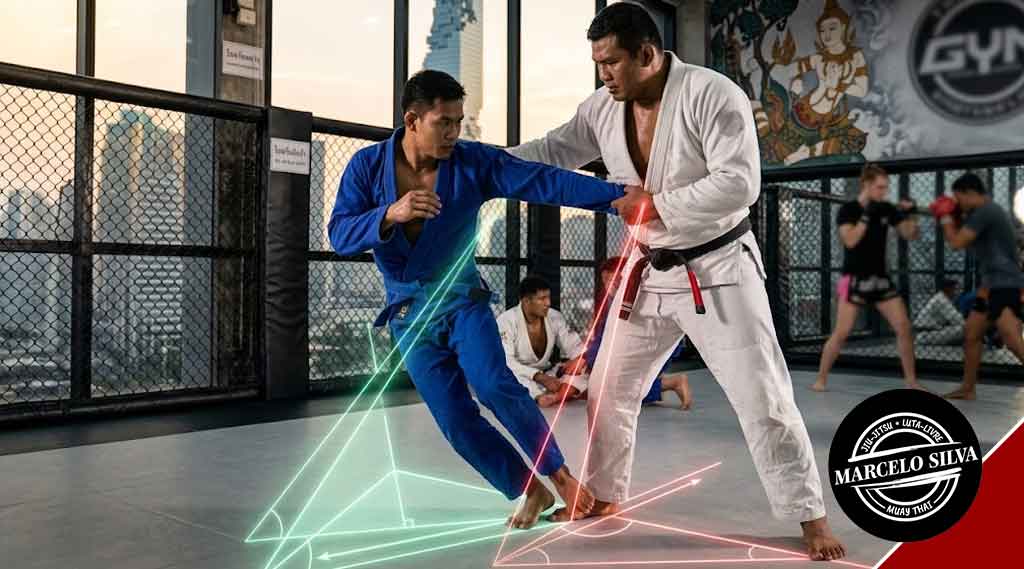
The solution to linear cage pressure lies in Angular Footwork Geometry. By employing the Check Hook Pivot, a defender shifts off the attacker’s driving track rather than fighting strength with strength.
Executing a 90-degree lateral pivot while snapping a lead check hook breaks the wrestler’s momentum, forces them toward the wall, and opens immediate channels for defensive escapes or offensive Brazilian Jiu-Jitsu counters.
At Marcelo Silva Martial Art, we teach athletes how to use spatial geometry to neutralize physical power. Our integrated combat programs empower the BJJ Bangkok community to turn defensive wall scrambles into technical, high-percentage victories.
The Pitfall of Linear Resistance: Why Wall Sprawling Fails Against Heavy Wrestlers
When an opponent drives forward in a straight line, fighting back in that same line forces a direct collision of mass and strength.
According to fundamental principles in human Anatomy, absorbing forward pressure while pinned against a wall places heavy strain on the lumbar spine, shoulders, and legs, making it difficult to maintain balance.
[Attacker Linear Drive] ➔ [Defender Static Resistance] ➔ [Defender Structural Compression] ➔ [Wall Takedown Accomplished]
[Industry-typical estimate] Biomechanical studies indicate that holding a static defensive frame against a driving wrestler against the cage increases upper-body muscle fatigue by up to 200% compared to open-mat scrambling.
If your back is flat against the cage padding, sprawling straight back is physically impossible because the wall blocks your hips.
To break free, you must alter the geometry of the engagement by moving laterally off the line of attack.
Biomechanics of the Check Hook Pivot: Kinetic Off-Balancing and Rotational Disruption
The Check Hook Pivot relies on stepping off the driving line, turning on the ball of the lead foot, and driving a lead hook across the opponent’s guard as they charge forward.
Applying key concepts from Sports science, this combination neutralizes linear pressure through three core biomechanical mechanisms:
Off-Axis Displacement: Rotating 90 degrees on your lead foot shifts your torso off the line of impact. The attacker’s forward momentum plunges into empty space toward the fence.
Cervical Spine Rotation (Kuzushi): Landing the check hook on the side of the opponent’s jaw creates rotational force across their cervical spine. Turning their head away from their path breaks their posture and prevents their feet from adjusting to your new angle.
Visual Interference: Swiping a glove across the opponent’s line of sight creates a momentary delay in visual processing. The attacker pauses to process the strike, blinding them to your lateral exit.
By stepping off the line of attack, martial artists at Marcelo Silva Martial Art learn to manage spatial pressure efficiently without relying on brute force.
Systemic Performance Matrix: Static Wall Resistance vs. Angular Check Hook Evasion
To assist tactical combat athletes in evaluating cage defense systems, this matrix compares traditional linear resistance against our angular footwork protocols:
| Tactical & Mechanical Variable | Static Wall Resistance (Linear Push) | Angular Check Hook Evasion | Long-Term Advantage Within BJJ Bangkok |
| Biomechanical Energy Expenditure | High (Forces core and shoulders to absorb momentum) | Low (Redirects forward force using off-axis footwork) | Reduces acute muscle fatigue during extended rounds |
| Spatial Alignment Post-Escape | Compressed against fence line | Shifted to a clear 90-degree open angle | Creates clear space for striking or re-engaging |
| Offensive Counter Opportunities | Restricted to defensive stalling or underhook battles | Exposes the attacker’s back for immediate rear body locks | Connects footwork evasions straight into Brazilian Jiu-Jitsu back-takes |
| Defensive Balance Integrity | Vulnerable to double-leg drive and foot sweeps | Maintains athletic stance and balanced center of gravity | Helps prevent being dragged to the mat in bad positions |
| Integration Across Combat Sports | Limited utility outside traditional wall wrestling | Blends seamlessly into MMA, Muay Thai, and Grappling | Builds versatile, adaptable Fight IQ across all Martial arts |
Tactical Scramble Control: From Cage Wall Evasion to Dominant Back Mount
Escaping cage pressure with a Check Hook Pivot often leaves the attacker off-balance, facing the wall. For a skilled grappler, this defensive maneuver quickly opens up offensive opportunities.
Rather than stepping back into open space, you can immediately take advantage of the opponent’s broken posture:
Securing the Rear Body Lock: As the attacker stumbles forward toward the wall pads, slide your lead arm around their waist and clasp a tight Gable Grip behind their spine.
Executing the Mat Return: Step your lead foot outside their base, break their balance laterally, and bring them down to the mat under total control.
Establishing Back Control: As they hit the canvas, insert your hooks or transition to a body triangle to establish a dominant back mount.
Turning a cage escape into an offensive back-take is a clear example of advanced Grappling strategy.
[Attacker Crashes Off-Balance] ➔ [Secure Rear Body Lock] ➔ [Execute Lateral Mat Return] ➔ [Establish Dominant BaIntegrating Striking Evasions with Modern Grappling Systems
High-level competition requires blending striking footwork and grappling defense into a single, cohesive system.
At Marcelo Silva Martial Art, we teach students how distance control in Muay Thai directly supports anti-takedown defense in Mixed martial arts.
Using angular footwork to slip linear attacks allows athletes to evade pressure, protect their hips, and control spatial geometry without draining energy.
Mastering High Fight IQ Combat Mechanics at Marcelo Silva Martial Art
Developing strong combat skills requires a clear, structured approach to technical training. At Marcelo Silva Martial Art, we break down complex wrestling and evasive footwork into clear, manageable drills.
Our curriculum guides students through level changes, wall resets, and positional transitions.
Whether you are a striker learning to avoid takedowns, an active competitor, or a beginner building practical self-defense skills, our academy provides a safe, structured environment for practitioners across BJJ Bangkok.
Conclusion: Take Control of Spatial Geometry in Bangkok
Being pressed against the cage by a heavy wrestler does not mean you are trapped. By adopting angular footwork and mastering the Check Hook Pivot, you can turn an attacker’s forward drive into an opportunity to take control and initiate dominant grappling attacks.
Elevate your skills with professional martial arts instruction in Thailand. Master spatial control, angular footwork, and submission transitions under expert guidance.
Step onto the mats at Marcelo Silva Martial Art today. Explore our training schedules, meet our coaching staff, and book your introductory trial session through our central digital portal at brazilianjiujitsubkk.com.
Frequently Asked Questions (FAQ)
Q1: How does angular footwork help escape cage pressure in combat sports?
A: Angular footwork shifts your body 90 degrees off the attacker’s driving line. Moving off-axis allows their forward momentum to plunge into empty space, helping you escape wall pressure without relying on brute force at Marcelo Silva Martial Art.
Q2: Why is sprawling straight back ineffective when pinned against the cage?
A: [Industry-typical estimate] Sprawling requires space behind your hips to extend your legs. When pinned against the fence padding, that space is blocked, forcing your upper body to absorb full linear pressure and increasing muscle fatigue by up to 200%.
Q3: What role does the Check Hook play during the lateral pivot?
A: The Check Hook impacts the side of the opponent’s jaw, applying rotational force to their cervical spine. This twists their head, breaks their posture, and prevents their feet from tracking your exit across BJJ Bangkok.
Q4: Can this cage escape technique set up offensive grappling attacks?
A: Yes. Pivoting often leaves the attacker off-balance and facing the wall. This positioning allows you to attach to their back, lock your arms around their waist, and execute a mat return into Brazilian Jiu-Jitsu back control.
Q5: Is this angular footwork curriculum safe for beginners?
A: Absolutely. At Marcelo Silva Martial Art, our instructors break these footwork patterns down into slow, controlled steps before applying pressure, ensuring a safe learning environment for all experience levels.
Q6: How can I register for a trial class at Marcelo Silva Martial Art in Bangkok?
A: Prospective students can check training schedules and reserve an introductory trial pass directly through brazilianjiujitsubkk.com.
Training Brazilian Jiu Jitsu in Bangkok offers not just physical benefits, but mental and social rewards as well. Avoiding these common beginner mistakes will help you build a solid foundation and enjoy the long-term benefits of BJJ.
At BrazilianJiuJitsuBKK.com, we welcome students of all levels. Our experienced instructors, international community, and central Bangkok location make us the ideal place to begin or continue your Brazilian Jiu Jitsu journey.
 English
  ไทย
ไทย