
Frame Manipulation Meta: Mastering Cross-Wrist Trapping for Stand-Up Disruption | BJJ Bangkok
Standing exchanges in modern combat sports are often defined by defensive stalling. When an opponent shells up behind a rigid high guard or extends forearm frames to block punches, launching direct strikes into their defensive shield wastes energy and exposes you to explosive counters.
Attempting to smash through a structured high guard using brute force rarely works against disciplined defenders.
Driving punches straight into forearm blocks simply allows the defender to absorb impact, gauge your timing, and reset their defensive stance.
The secret to breaking static standing guards lies in Frame Manipulation Mechanics. Borrowing centerline disruption concepts from Wing Chun and adapting them for open-hand control, top fighters utilize Cross-Wrist Trapping to peel away forearm barriers.
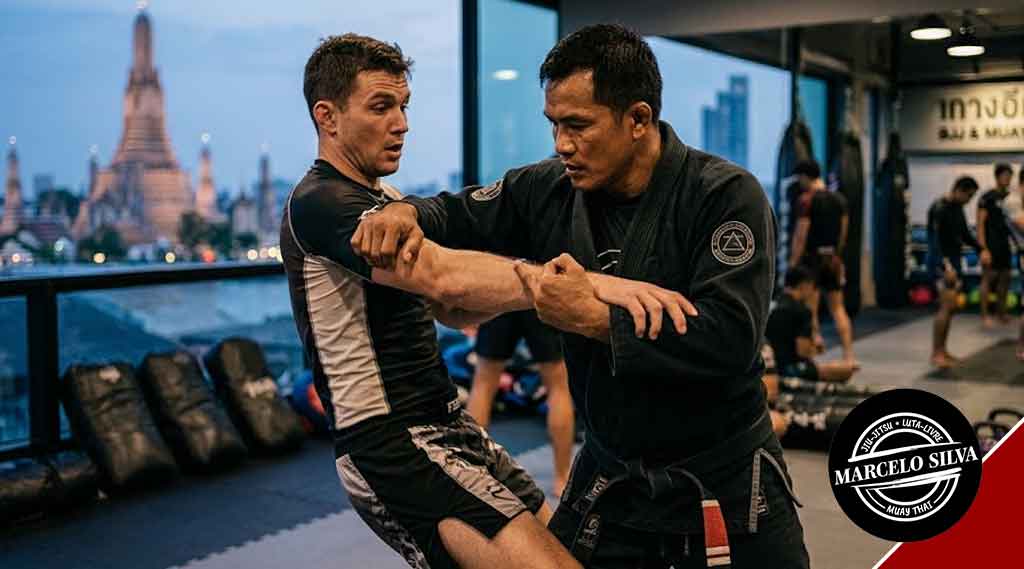
Grabbing the opponent’s opposite wrist and pulling it across their torso forces their shoulder axis to rotate.
Displacing their guard off the centerline opens clear striking lanes for vertical elbows and creates instant pathways into dominant clinches.
At Marcelo Silva Martial Art, we teach practitioners how to manipulate human leverage to disassemble tight defensive guards. Our integrated system empowers the BJJ Bangkok community to transition standing wrist control seamlessly into world-class Brazilian Jiu-Jitsu submission mechanics.
The High Guard Trap: Why Traditional Punching Stalls Against Structural Frames
Why do conventional punches frequently fail to break a tight shell guard?
According to functional human Anatomy, the bones of the forearm—the radius and ulna—form a natural protective barrier when tucked vertically alongside the head. When backed by the large muscles of the upper back and shoulder, this structure can absorb heavy direct impacts.
[Direct Punch Thrust] ➔ [Impacts Vertical Forearm Frame] ➔ [Force Absorbed by Shoulder] ➔ [Defender Counters]
[Industry-typical estimate] Analytical combat studies indicate that throwing direct strikes into a structured high guard typically results in less than a 25% clean connection rate, while significantly increasing hand fatigue and muscle strain.
Instead of hitting the barrier, frame manipulation pulls the barrier away.
By applying a lateral cross-wrist pull, you target the weaker rotational planes of the shoulder joint, rendering the rigid guard completely useless.
Biomechanics of Cross-Wrist Trapping: Deconstructing Centerline Control
The Cross-Wrist Trap operates by reaching across the opponent’s body with your lead hand to secure their opposite wrist, then snapping it diagonally downward across their navel.
Applying core principles from Sports science, this cross-body pull disrupts the defender’s posture through three main physiological actions:
-
Rotational Axis Displacement: Pulling the defender’s wrist past their vertical centerline forces their lead shoulder to dip forward, exposing the side of their neck and chin.
-
Inhibition of Rear Guard Defense: Snapping the lead arm across the body physically blocks the defender’s rear hand, making it impossible for them to bring their opposite glove across to protect their open jaw line.
-
Unbalancing the Pelvis: Rapidly pulling an upper extremity across the body’s midline shifts the defender’s center of gravity onto their front toes, preventing them from driving forward with counter-strikes.
[Secure Cross-Wrist Grip] ➔ [Diagonal Snap Across Midline] ➔ [Shoulder Axis Rotates] ➔ [Centerline Open for Attack]
By mastering this directional pull, martial artists at Marcelo Silva Martial Art learn to peel open defensive shells without expending unnecessary power.
Systemic Performance Matrix: Blind Guard Punching vs. Cross-Wrist Control Systems
To assist technical martial artists in evaluating stand-up guard manipulation, this matrix compares direct punch thrusts against our cross-wrist trapping protocol:
| Mechanical & Tactical Variable | Blind Guard Punching | Cross-Wrist Control Systems | Strategic Advantage Within BJJ Bangkok |
| Defensive Barrier Management | Collides directly with forearm frames | Peels frames laterally off the centerline | Prevents hand trauma and conserves stamina |
| Striking Target Access | Low (Punches land on elbows and gloves) | Extremely High (Exposes the neck, jaw, and liver) | Dramatically increases short-range strike precision |
| Clinch & Takedown Readiness | Disjointed (Must stop striking to shoot) | Direct (Wrist pull glides straight into ties) | Blends striking seamlessly into Brazilian Jiu-Jitsu |
| Opponent Posture Control | Zero posture disruption on defender | Forces shoulder rotation and pelvic off-balancing | Keeps opponent constantly defensive and reactive |
| Cross-Disciplinary Versatility | Standard striking range | Combines striking with grappling mechanics | Integrates Muay Thai elbows with wrestling controls |
Clinch Integration: Translating Hand Traps into Standing Grappling Controls
In modern Mixed martial arts and combat sports, the true power of a hand trap lies in its ability to bridge standing strikes directly into Grappling dominance.
Once you execute a cross-wrist pull, you can immediately transition into high-percentage standing controls:
-
The Arm Drag Back Take: As you pull the opponent’s wrist across their centerline, step your lead foot outside their lead leg. Reach under their armpit to secure their rear shoulder, sliding directly behind them to take the back.
-
The Russian 2-on-1 Tie: Clamp both of your hands onto the trapped arm—one on the wrist, one on the triceps. Drive your shoulder into their upper arm to break their balance, setting up single-leg takedowns or trip sweeps.
-
Standing Submission Counters: If the defender attempts to pull their trapped arm back violently, use their backward momentum to wrap their bent arm into a standing Kimura trap or wrist lock.
                  ┌───> [Arm Drag Entry]     ───> [Secure Standing Rear Body Lock]
[Cross-Wrist Trap] ┼───> [Russian 2-on-1 Tie] ───> [Execute Off-Balancing Trip Sweep]
                  └───> [Kimura Trap Clamp]  ───> [Transition to Standing Submission]
Advanced Stand-Up Systems at Marcelo Silva Martial Art
Developing complete Fight IQ requires moving beyond basic striking or isolated grappling drills.
At Marcelo Silva Martial Art, our curriculum teaches athletes how to weave standing frame manipulation, clinch controls, and ground submissions into a single fluid system.
Guided by experienced coaches, members of our BJJ Bangkok community learn to analyze leverage, manipulate posture, and dictate fight pacing safely and efficiently.
Conclusion: Peel the Guard, Command the Stance
Breaking down a tough defensive shell does not require harder punches; it requires smarter leverage. By utilizing Cross-Wrist Trapping to manipulate defensive frames, you strip away your opponent’s guard and control the fight.
Elevate your technical skills with professional combat instruction in Thailand. Master frame disruption, standing clinch entries, and submission setups under expert guidance.
Step onto the mats at Marcelo Silva Martial Art today. Explore our class schedules, meet our coaching team, and reserve your trial session through our central portal at brazilianjiujitsubkk.com.
Frequently Asked Questions (FAQ)
Q1: How does Cross-Wrist Trapping break an opponent’s high guard?
A: Cross-Wrist Trapping works by grabbing the opponent’s opposite wrist and pulling it diagonally across their torso. This forces their shoulder axis to rotate, peeling their forearm frame off their centerline at Marcelo Silva Martial Art.
Q2: Why is hitting a rigid high guard inefficient in stand-up fighting?
A: [Industry-typical estimate] Forearm frames backed by the shoulders easily absorb direct impacts. Studies show punching directly into structured guards connects cleanly less than 25% of the time while draining the attacker’s hand and shoulder stamina in BJJ Bangkok.
Q3: How does hand-trapping lead into a back take?
A: Snapping the opponent’s wrist across their body exposes their rear shoulder. By stepping to the outside and reaching under their armpit (an Arm Drag), you can bypass their guard and secure standing back control in Brazilian Jiu-Jitsu.
Q4: Can this hand-trapping system be used in No-Gi grappling?
A: Yes. The technique relies on grabbing major anatomical levers (the wrist joint and forearm) rather than cloth grips, making it highly effective in both No-Gi grappling and small-glove combat sports.
Q5: How do I avoid getting hit while reaching across for a wrist trap?
A: At Marcelo Silva Martial Art, our coaches instruct students to move their head off the centerline and raise their lead shoulder as they initiate the trap, ensuring total defensive cover against counter punches.
Q6: How can I register for an introductory session at Marcelo Silva Martial Art in Bangkok?
A: Prospective students can check class schedules and book an introductory trial session directly online at brazilianjiujitsubkk.com.
Training Brazilian Jiu Jitsu in Bangkok offers not just physical benefits, but mental and social rewards as well. Avoiding these common beginner mistakes will help you build a solid foundation and enjoy the long-term benefits of BJJ.
At BrazilianJiuJitsuBKK.com, we welcome students of all levels. Our experienced instructors, international community, and central Bangkok location make us the ideal place to begin or continue your Brazilian Jiu Jitsu journey.


 English
  ไทย
ไทย