The False Reap Entry Meta: Deconstructing Biomechanical Torque to Counter Heavy Base Stances in Brazilian Jiu-Jitsu | BJJ Bangkok
In modern high-level No-Gi grappling competition, top-position passers have adapted aggressively to standard open guard entries. When guard players attempt to invert or insert K-Guard hooks, experienced passers counter by dropping their hips low, widening their stance, and establishing a heavy-base posture.
This low center of gravity closes off interior space, rendering traditional vertical lifts and standard overhead sweeps physically draining and ineffective.
To bypass this defensive wall, elite submission grapplers have embraced the “False Reap Entry Meta.”
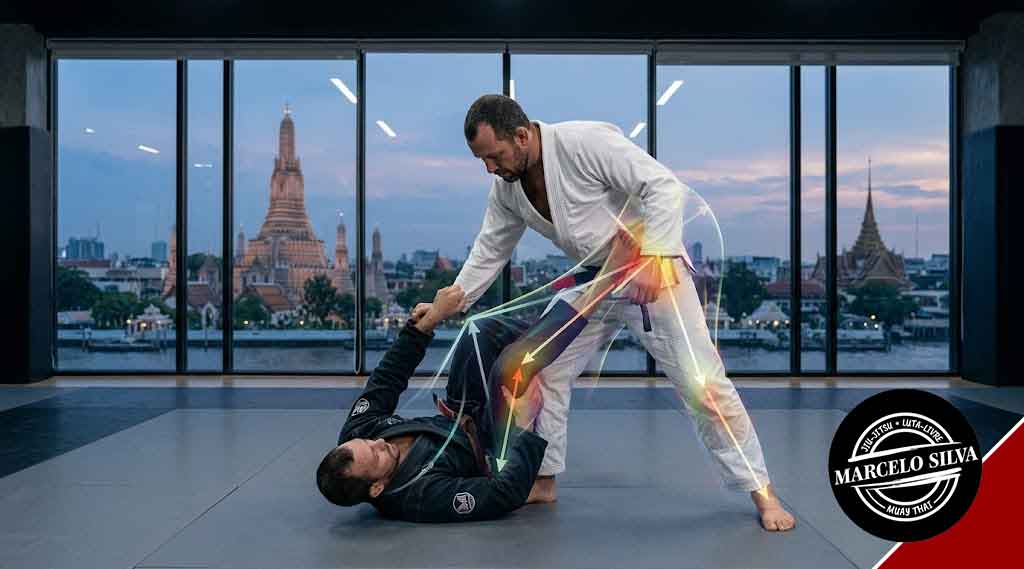
Rather than attempting to lift an opponent’s entire body weight against gravity, the False Reap utilizes an outside ankle hook combined with horizontal rotational hip torque underneath the passer’s center of mass. This entry seamlessly collapses the heavy stance, transitioning directly into the Honey Hole / Saddle (Inside 411) position for high-percentage Heel Hooks and Knee Bars.
At Marcelo Silva Martial Art, we continuously update our instructional curriculum to reflect cutting-edge competition mechanics. Our Brazilian Jiu-Jitsu programs avoid reliance on brute strength, teaching practitioners across BJJ Bangkok how to leverage scientific principles to counter heavy pressure passers with maximum efficiency.
Beyond K-Guard: The Emergence of the False Reap in Modern Grappling
Against upright passers, inserting a K-Guard hook behind the knee pit is straightforward. However, when modern passers lower their hips until their glutes sit near their heels, K-Guard entry space disappears.
According to principles of human Anatomy, a low, heavy base transfers over 80% of the passer’s body weight directly down into their heels and ankles. Attempting to lift this structure vertically fights directly against gravitational resistance. Yet, this pinned base exposes a key vulnerability: the immobilized outside ankle line.
[Passer Low Heavy Base] ➔ [Lead Shin Outside Ankle Hook (False Reap)] ➔ [Rotational Hip Torque] ➔ [Invert to Saddle / Honey Hole]
The False Reap capitalizes on this fixed pivot point. By switching the target from the interior knee pit to the outside ankle line, modern Grappling practitioners convert a heavy passing base into a self-entangling trap.
Biomechanics of the False Reap: Rotational Torque Over Brute Force
The False Reap structure uses the bottom player’s lead ankle and shin to wrap across the passer’s lead leg, hooking the outside ankle line while controlling the heel. This forms a tight two-point anchor system that isolates the leg below the knee joint.
Incorporating core concepts from clinical Sports science, the False Reap operates through distinct biomechanical principles:
Planar Rotational Torque: Instead of forcing a vertical lift, the bottom player rotates their hips horizontally along the mat, driving internal knee rotation into the passer’s lead leg.
Ankle Fixing: Anchoring the passer’s outside ankle prevents their knee from flaring outward to absorb force, directing rotational torque straight into their hip joint.
Center of Mass Displacement: Inducing internal knee rotation forces the passer’s hips to collapse onto the mat regardless of how heavy or low their initial stance was.
Practitioners at Marcelo Silva Martial Art master these rotational mechanics, enabling our BJJ Bangkok members to defeat larger, heavier opponents systematically.
Strategic Comparison Matrix: Standard K-Guard vs. Modern False Reap Meta
To assist analytical competitors in evaluating technical guard selection, this matrix contrasts standard K-Guard entries against our False Reap protocols:
| Technical & Tactical Metric | Standard K-Guard Entry | Modern False Reap Meta | Tournament Advantage Within BJJ Bangkok |
| Handling Heavy Base Stances | Challenging (entry is blocked by low hip posture) | Excellent (uses the immobilized outside ankle as a pivot) | Neutralizes heavy pressure passers completely |
| Primary Force Vector | Vertical Lift (requires lifting opponent’s mass upward) | Rotational Torque (rotates hips horizontally along mat) | Conserves muscular stamina during guard entries |
| Primary Anchor Point | Outside Knee Pit | Outside Ankle & Heel Line | Anchors the passer’s foot firmly to prevent escape |
| Target Entanglement Landing | Matrix Back Take / 50-50 Guard | Honey Hole / Saddle (Inside 411) | Transitions directly into dominant leg control |
| Joint Longevity Profile | High stress on lumbar spine during heavy stack pressure | Rotational hip leverage that minimizes spinal compression | Protects body integrity for long-term athlete durability |
Entry to Entanglement: Transitioning from False Reap to Honey Hole / Saddle
Once the passer’s base collapses to the mat, inside leg entanglements open immediately. The False Reap guides your legs between the opponent’s thighs, capturing the premier leg lock position: the Honey Hole (Saddle / Inside 411).
                  ┌───> [Path A: Inside Heel Hook] ───> [Rotational Joint Lock / Tapout]
[False Reap Hook] ──┤
                  └───> [Path B: Straight Knee Bar] ───> [Hyperextension of Knee Joint]
Path A: Inside Heel Hook Execution
Inside the Saddle, the defender’s leg is isolated and separated from their secondary base. Exposing the heel allows immediate application of an Inside Heel Hook, generating controlled rotational force against the knee ligaments for high-percentage submission finishes in Brazilian Jiu-Jitsu.
Path B: Straight Knee Bar Counter
If the opponent attempts to straighten their leg or hide the heel to escape the twist, the Saddle structure allows an immediate adjustment into a Knee Bar, driving hip pressure directly into the extended knee joint to force a tapout.
Master Modern Leg Entanglements at Marcelo Silva Martial Art
Staying ahead in modern combat sports requires understanding the underlying science behind every movement. Marcelo Silva Martial Art takes pride in delivering the most progressive Brazilian Jiu-Jitsu instruction in Thailand.
We blend foundational concepts across various Martial arts—from distance management in Muay Thai to cage adaptations in Mixed martial arts (MMA)—into our submission grappling programs. Our coaching team ensures every athlete in BJJ Bangkok masters the False Reap safely, technically, and effectively.
Conclusion: Turning Heavy Base Stances into Lethal Traps
Facing a passer with a heavy, low stance is no longer a dead end for guard players; it is the ideal setup for a False Reap entry. Embracing modern leg-lock metas enhances your overall Fight IQ and provides a reliable pathway to victory on the mats.
Elevate your grappling skills with world-class instruction in Thailand. Join our structured classes at Marcelo Silva Martial Art today and redefine your submission performance right here in BJJ Bangkok.
Frequently Asked Questions (FAQ)
Q1: What is the False Reap entry in Brazilian Jiu-Jitsu and how does it differ from K-Guard?
A: The False Reap hooks the passer’s outside ankle rather than entering deep behind the knee pit like K-Guard. It uses horizontal rotational torque to break down heavy, low passing stances, sweeping the passer directly into the Saddle at Marcelo Silva Martial Art.
Q2: Why is the False Reap entry so effective against larger, heavy-base opponents?
A: The False Reap does not require lifting an opponent’s body weight against gravity. Instead, it forces internal knee rotation, causing the opponent’s hips to collapse onto the mat regardless of their size across BJJ Bangkok.
Q3: What is the Honey Hole or Saddle position in No-Gi grappling?
A: The Honey Hole (also known as the Saddle or Inside 411) is a dominant leg entanglement where both of your legs control one of your opponent’s legs from the inside. It insulates you from counter-attacks while setting up high-percentage submissions.
Q4: Is practicing False Reaps and leg locks safe for recreational BJJ practitioners?
A: Yes. At Marcelo Silva Martial Art, we prioritize strict safety protocols. Coaches teach leg entanglements using slow, controlled catch-and-release mechanics, ensuring a safe learning environment for practitioners of all skill levels.
Q5: What submission options are available if an opponent defends the Inside Heel Hook?
A: If an opponent straightens their leg to hide their heel, the Saddle position allows you to transition smoothly into a Straight Knee Bar or attack the secondary leg for a toe hold.
Q6: How can I join No-Gi submission grappling classes at Marcelo Silva Martial Art in Bangkok?
A: Prospective students, competitors, and visiting grapplers can view training schedules and reserve an introductory trial session directly online through brazilianjiujitsubkk.com.
Training Brazilian Jiu Jitsu in Bangkok offers not just physical benefits, but mental and social rewards as well. Avoiding these common beginner mistakes will help you build a solid foundation and enjoy the long-term benefits of BJJ.
At BrazilianJiuJitsuBKK.com, we welcome students of all levels. Our experienced instructors, international community, and central Bangkok location make us the ideal place to begin or continue your Brazilian Jiu Jitsu journey.


 English
  ไทย
ไทย