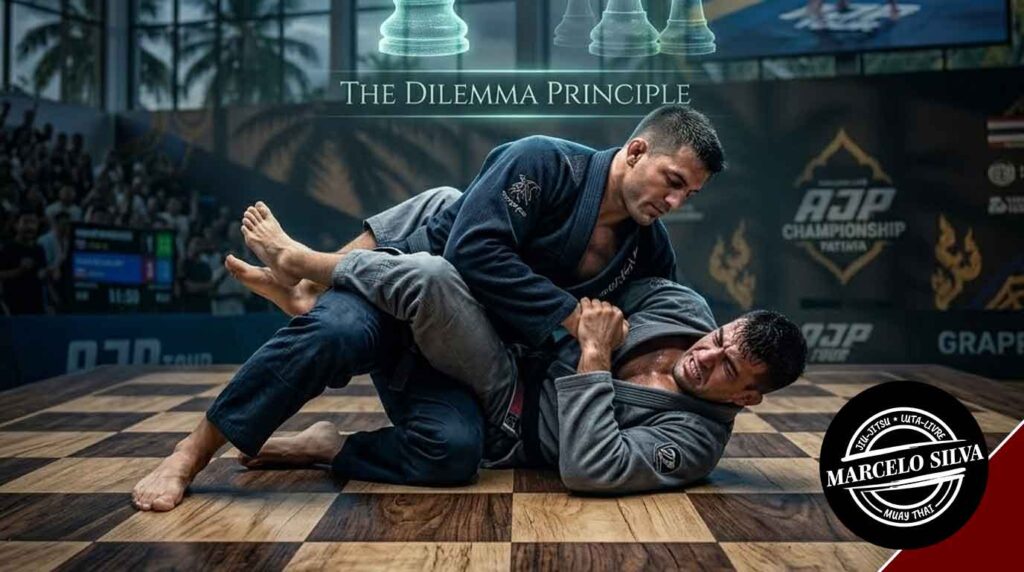
⚖️ “The Dilemma Principle”: The Art of Creating “Bad Choices” for Your Opponent (Left vs. Right or Upper vs. Lower)
Introduction: Stop Playing Rock-Paper-Scissors, Start Playing Chess
Do you ever feel like fighting a skilled opponent is like chasing shadows? You try to pass to the left; they block. You try to apply a choke; they defend. Every time you launch a single attack, they have a single answer. It feels like a frustrating game of Rock-Paper-Scissors where you play Scissors, and they always play Rock.
The problem isn’t your speed or the quality of your move. The problem is that you are giving them a “Good Choice.” Single attacks allow your opponent a clear, singular path to safety.
Elite Brazilian Jiu-Jitsu (Wikipedia) players don’t do this. They utilize a high-level strategic concept called “The Dilemma Principle.”
This article dives deep into the art of creating “Bad Choices”—forcing your opponent to pick their own poison. This mindset is the core of the Marcelo Silva Martial Arts curriculum taught at BJJ Bangkok.
What is a Dilemma? (The Fork Theory)
Problem vs. Dilemma
In tactical terms, there is a massive difference between a problem and a dilemma:
-
A Problem: You attack with Move A (e.g., an Armbar). The opponent has one problem to solve. They pull their arm out. They are safe. The problem is solved.
-
A Dilemma: You attack with Move A and Move B simultaneously (or in such quick succession that they overlap). If they defend A, they are exposed to B. If they defend B, they are caught by A. No matter what they choose, they lose.
In the world of Chess (Wikipedia), this is known as “The Fork”—a tactic where a single piece makes two or more direct attacks simultaneously.
In BJJ, as the legendary coach John Danaher famously states: “Your job is not to overcome the opponent’s defense, but to make their defense meaningless.”
Upper vs. Lower (The Vertical Dilemma)
This is the most classic form of the dilemma: forcing the opponent to choose between protecting their “Neck/Head” (Upper) or their “Base/Limbs” (Lower).
Case Study: Hip Bump Sweep vs. Kimura
This is a staple taught in the Fundamentals class at BJJ Bangkok:
-
Attack A (Base): You sit up and explode your hips for a Hip Bump Sweep.
-
The Reaction: To avoid being swept, the opponent must post their hand on the mat.
-
Attack B (Arm): The moment they post their hand to save their base, they isolate their arm, creating a perfect entry for the Kimura lock.
Case Study: Cross Choke vs. Armbar
From the Mount position:
-
Attack A (Neck): You reach deep into the collar for a Cross Choke.
-
The Reaction: The opponent raises their hands to defend their neck.
-
Attack B (Arm): By raising their hands, their elbows leave their ribcage, creating the space for you to slide into an Armbar.
Left vs. Right (The Horizontal Dilemma)
This is the primary tool for elite Guard Passing. If you try to pass only in one direction, your opponent can build a wall. If you create a Left-Right dilemma, that wall crumbles.
The Torreando Pass (The Bullfighter)
-
Attack A (Left): You aggressively throw their legs to the left.
-
The Reaction: The opponent uses their Biomechanics (Wikipedia) to resist, pushing their legs back to the right to prevent the pass.
-
Attack B (Right): You don’t fight their strength. You use their own resistance and momentum to “redirect” their legs all the way to the right, passing effortlessly to the left.
In the Marcelo Silva Martial Arts system, we teach that speed is a secondary factor; Timing the Resistance is the true key to the horizontal dilemma.
Front vs. Back (The Orientation Dilemma)
The Deadly Triangle (Triangle vs. Omoplata)
-
Attack A (Front): You lock a Triangle Choke from the guard.
-
The Reaction: The opponent tries to “posture up” or hide their head to avoid the choke.
-
Attack B (Back/Shoulder): Their defensive movement often requires them to lean away, exposing their shoulder for a transition into the Omoplata.
At BJJ Bangkok, we train our students to be “multidimensional.” If the front door is locked, the back door is already swinging open.
Training the Mindset at BJJ Bangkok
Implementing “The Dilemma Principle” doesn’t happen by accident. It requires a shift from “Move-based” training to “System-based” training.
Under the Marcelo Silva Martial Art methodology, we use Chain Drills:
-
The “Either/Or” Drill: One partner is the designated defender. You launch Attack A. If they defend it one way, you must transition to Attack B. If they defend it another way, you finish Attack A.
-
Positional Strategy: We analyze where your “favorite” moves are getting stuck and help you find the “Partner Move” that creates a dilemma for your opponent.
Conclusion: Become the Architect of Fate
Understanding “The Dilemma Principle” elevates you from a mere fighter to a master strategist. You are no longer hoping to find an opening; you are designing a win by forcing your opponent down a path of your choosing.
Whether they turn left or right, protect their neck or their arms, the destination remains the same: your victory.
This is the beauty of Jiu-Jitsu as “Human Chess.” If you want to learn this systematic, intelligent approach to combat, join us at BJJ Bangkok. Discover that the sweetest victory is the one won with intellect and efficiency.
“Give them two choices, and make sure both are wrong.”
Frequently Asked Questions (FAQ)
Q1: How is a Dilemma different from a Combination? A: A combination is a sequence (Move 1, then 2, then 3). A Dilemma is two threats presented so closely together that the defense of one mechanically causes the opening for the other.
Q2: Should beginners (White Belts) try to use Dilemmas? A: Beginners should first master the mechanics of single attacks. Once you can perform a basic Armbar or Sweep, we start teaching you how to pair them at BJJ Bangkok.
Q3: What is the best Dilemma for older grapplers (30+)? A: The Position vs. Submission dilemma. Threaten a guard pass (Position) to make them panic and expose their neck for a choke (Submission). This saves a massive amount of energy.
Q4: Do I need to be fast to make a Dilemma work? A: No. In fact, doing it too fast can sometimes mask the opponent’s reaction. Precision and timing are far more important than raw speed.
Q5: How can I find my own Dilemmas? A: Look at the “Move A” that you use most often. Ask yourself: “How does my opponent usually defend this?” Then, find a “Move B” that attacks exactly where they are exposed during that defense.
Training Brazilian Jiu Jitsu in Bangkok offers not just physical benefits, but mental and social rewards as well. Avoiding these common beginner mistakes will help you build a solid foundation and enjoy the long-term benefits of BJJ.
At BrazilianJiuJitsuBKK.com, we welcome students of all levels. Our experienced instructors, international community, and central Bangkok location make us the ideal place to begin or continue your Brazilian Jiu Jitsu journey.

 English
  ไทย
ไทย